 Post by
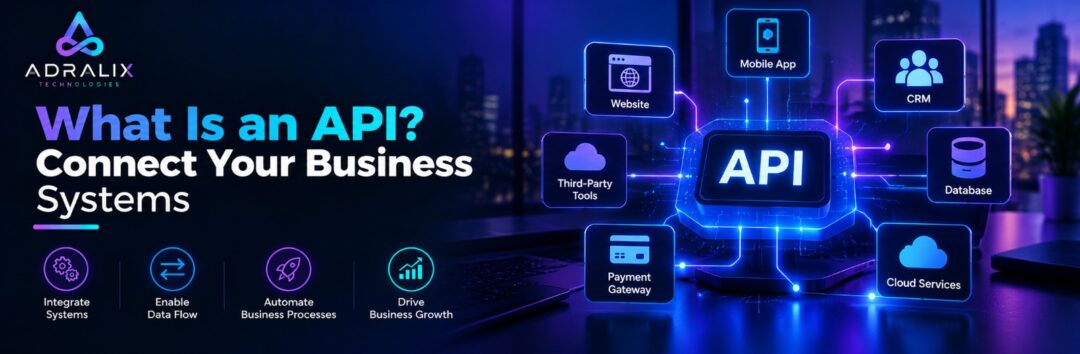
What Is an API, and why does it matter when businesses build digital products? An API, or Application Programming Interface, enables different software systems to communicate through defined rules. APIs allow websites, mobile applications, databases, payment gateways, and business platforms to exchange information without requiring every system to be rebuilt as one application.
For businesses, APIs can connect disconnected tools, automate information exchange, and support more connected customer experiences. Understanding how APIs work helps decision-makers plan integrations, evaluate software requirements, and choose the right development approach.
Quick Answer: What Is an API?
An API is a defined interface that allows one software component to request functionality or data from another. It specifies how a request should be made, what information can be exchanged, and how the receiving system responds.
Think of an online store. When a customer checks an order, the website may request information from a backend service. That service retrieves the order details and returns them so the website can display the correct status. The API defines how this communication takes place.
Key Facts About APIs
- An API establishes rules for communication between software components.
- APIs can connect web applications, mobile apps, databases, and third-party platforms.
- API requests and responses may contain structured data, such as JSON.
- Authentication and authorization help control access to protected API functionality.
- API documentation describes available endpoints, parameters, responses, and requirements.
- APIs can support automation by enabling systems to exchange information without manual re-entry.
An API does not necessarily mean a public interface. APIs may be private to an organization, shared between business partners, or made available to external developers.
API Integration: How Applications Exchange Data
API Integration connects two or more systems so information or functionality can move between them. Instead of operating as isolated tools, integrated applications can exchange data through defined interfaces.
Consider a business that receives online orders. Without suitable integrations, employees may need to copy order information from the website into inventory, accounting, or customer management systems. An API-based workflow can reduce this repeated work when the connected systems support the required operations.
Common API integration use cases include:
- Payments: Connect checkout experiences with payment providers.
- Customer management: Exchange lead or customer information with a CRM.
- Inventory: Synchronize product availability and order information.
- Communication: Connect applications with email, messaging, or notification services.
- Reporting: Collect relevant information from different business platforms.
- Mobile applications: Allow mobile apps to access backend data and functionality.
| Business Requirement | How API Integration Helps |
| Online payments | Sends transaction requests to a payment service |
| Customer records | Exchanges permitted customer information |
| Inventory updates | Shares stock and product data |
| Appointment booking | Connects booking interfaces with scheduling systems |
| Mobile app accounts | Retrieves account information from backend services |
| Business reporting | Combines information from supported data sources |
The important consideration is that integrations depend on the capabilities, permissions, data formats, and reliability of the systems involved. Connecting applications is not simply a matter of exchanging data. The workflow must also handle failures, duplicate requests, access restrictions, and changes to the connected systems.
Adralix supports web and mobile applications that require APIs and third-party integrations through its Web Development Services and App Development Services.
REST API: What Are the Common API Approaches?
A REST API is an API designed around the principles of Representational State Transfer. REST commonly uses HTTP methods to interact with resources, such as retrieving a record, creating an order, updating information, or deleting an item when permitted.
Other API approaches may suit different application requirements.
| API Approach | Typical Purpose | Considerations |
| REST | Resource-based web communication | Widely used for web and mobile integrations |
| GraphQL | Requesting specific data fields through a query interface | Requires schema and query management |
| WebSocket | Two-way communication over a persistent connection | Useful for real-time interactions |
| RPC-style APIs | Calling defined operations or procedures | Fits workflows organized around specific actions |
These approaches are not interchangeable in every situation. REST may suit a conventional business application, while GraphQL can help when clients need flexible data selection. WebSockets can be relevant to real-time dashboards, collaborative tools, or live updates.
Selecting an API approach requires understanding data requirements, latency expectations, security, caching, integrations, and the skills available to maintain it. Your API architecture should follow the product’s needs rather than a trend or technology preference.
API Development Services: What Should Businesses Plan?
Reliable API Development Services cover more than creating endpoints. The API must be understandable, secure, maintainable, and appropriate for the applications and teams that depend on it.
Before development begins, businesses should clarify:
- Purpose: What application or business process needs to communicate with another system?
- Data: What information needs to be exchanged, and which system owns it?
- Access: Who or what is permitted to make requests?
- Validation: How will invalid, incomplete, or unauthorized requests be handled?
- Errors: What happens when a service is unavailable or a request fails?
- Monitoring: How will errors, latency, and unusual activity be reviewed?
- Versioning: How will changes be introduced without unexpectedly breaking existing integrations?
- Documentation: How will developers understand and maintain the interface?
API security also requires attention. Authentication confirms identity, while authorization determines what an identity is permitted to access. Sensitive information should not be exposed simply because an application can technically request it.
Businesses should also evaluate rate limits, logging, data validation, dependency management, and how external services affect reliability.
How Adralix Supports API-Connected Applications
APIs are often one layer of a broader digital product. A website may need backend services, a mobile app may need account and payment integrations, and an internal application may need to connect with existing business systems.
Adralix’s published capabilities span web development, mobile app development, backend engineering, and full-stack development. Relevant options include its NodeJS Development Services and Python Development Services, both of which cover API-related development capabilities.
For planning, Adralix’s existing guide on choosing the right technology stack for your web application can help frame decisions about architecture, frameworks, and long-term maintenance.
The right solution begins with the business workflow, the systems involved, and the information that needs to move between them. From there, API design and integration can be planned around security, maintainability, and the expected user experience.
Frequently Asked Questions About APIs
What is an API used for?
An API allows software components to exchange data or use each other’s functionality through defined interfaces. Common examples include payments, login, shipping, customer records, and mobile app connections.
What is API Integration?
API Integration connects software systems so they can exchange information or trigger permitted actions. It can reduce manual data entry and help coordinate workflows across supported platforms.
When should a business use REST API development?
REST API development can suit applications that expose resources through standard HTTP requests. The final design should account for data structure, access control, error handling, versioning, and the needs of consuming applications.
What should businesses expect from API Development Services?
API Development Services may include requirements analysis, API design, implementation, authentication, documentation, integration testing, monitoring, and ongoing maintenance, depending on the project scope.
Conclusion
What Is an API becomes easier to understand when viewed as the communication layer connecting digital products and business systems. APIs help websites, mobile applications, databases, payments, and other platforms exchange information through defined interfaces.
For businesses, effective API planning involves more than connecting endpoints. Data ownership, permissions, error handling, security, documentation, and maintenance all matter. Adralix Technologies supports web, mobile, backend, and full-stack development requirements where APIs and integrations form part of the solution.
The objective is to connect systems in a way that supports business workflows today while remaining maintainable as requirements change.