 Post by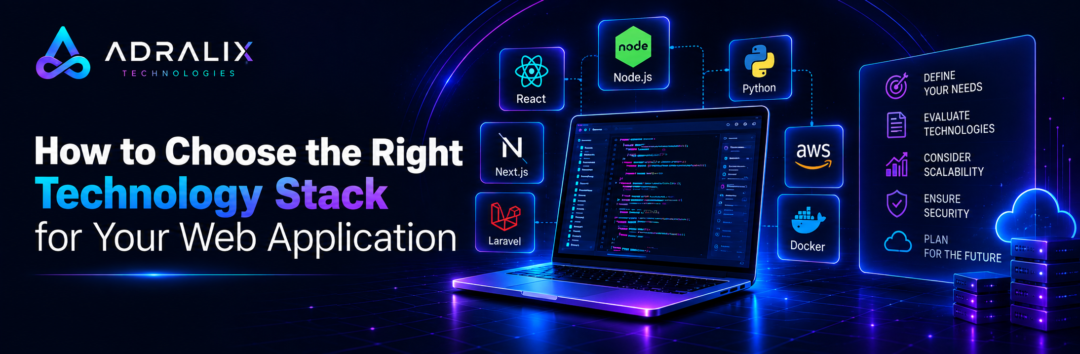
Choosing a technology stack is one of the most important decisions you’ll make before developing a web application.
It affects how the application is built, how quickly your team can release features, how easily the product can scale, how much it costs to maintain, and how difficult it may be to change direction later.
But there is no universally best technology stack for a web application.
A startup building an MVP, an enterprise creating an internal platform, a SaaS company launching a global product, and an eCommerce business serving a large customer base may all need very different technologies.
That is why how to choose the right technology stack for your web application should begin with business and product requirements, not with whichever programming language or framework is trending.
The technology landscape is changing quickly. GitHub’s 2025 Octoverse report found that TypeScript became the most-used language on GitHub in August 2025, overtaking Python and JavaScript for the first time. The report also shows that Python remains particularly important for AI and data-science workloads, while JavaScript and TypeScript together continue to represent a very large development ecosystem.
JetBrains’ 2025 Developer Ecosystem Survey, based on responses from 24,534 developers across 194 countries, found that 85% of developers regularly use AI tools for coding and development, while 62% rely on at least one AI coding assistant, agent, or code editor.
These trends are important, but they do not mean you should automatically choose the most popular technology.
Popularity can inform your decision. It should not make the decision for you.
What Is a Web Application Technology Stack?
A web application technology stack is the collection of technologies used to build, run, and maintain a web application.
A typical stack includes several layers.
Frontend
The part of the application users interacts with in their browser.
Common technologies include:
- ReactJS
- NextJS
- Angular
- HTML
- CSS
- JavaScript
- TypeScript
Backend
The server-side layer responsible for business logic, APIs, authentication, data processing, and application services.
Common technologies include:
- NodeJS
- PHP
- Laravel
- Python
- Java
Database
The system used to store and retrieve application data.
Examples include:
- MongoDB
- PostgreSQL
- MySQL
- Other SQL and NoSQL databases
APIs and Integrations
The communication layer connecting the application with:
- Payment gateways
- CRMs
- ERPs
- Authentication services
- External APIs
- Mobile applications
- Third-party platforms
Infrastructure
The environment where the application runs, including hosting, cloud services, networking, caching, deployment, and monitoring.
Development and Quality Tools
These may include:
- Version control
- CI/CD
- Automated testing
- Manual QA
- Monitoring
- Logging
- Security tooling
The important point is that a technology stack is an ecosystem, not simply a programming language.
Why Choosing the Right Stack Matters
A technology decision made early can influence a product for years.
The wrong choice can contribute to:
- Slower development
- Higher maintenance costs
- Performance issues
- Hiring challenges
- Integration difficulties
- Security concerns
- Technical debt
- Expensive migrations
A suitable technology stack can instead provide a stronger foundation for:
- Product development
- Scalability
- Performance
- Maintainability
- Integrations
- Future expansion
The goal isn’t to choose the most advanced stack.
The goal is to choose a stack that is appropriate for the product you’re actually building.
Start With the Application, Not the Technology
Before comparing ReactJS, NextJS, NodeJS, Python, Java, PHP, or other technologies, answer a more fundamental question:
What are you actually building?
A marketing website and a multi-tenant SaaS platform don’t need the same architecture.
An internal dashboard and a high-traffic consumer application have very different priorities.
A content-heavy website and a real-time collaboration product may require different approaches altogether.
Start by defining:
- What the application does
- Who will use it
- What users need to accomplish
- What data it will process
- Which systems it must connect to
- How quickly it needs to launch
- How the product may evolve
Once those questions are clear, technology selection becomes much easier.
-
Define Your Business Requirements
The first stage of technology stack selection is understanding the business problem.
Ask:
What is the product supposed to achieve?
For example:
A CRM may prioritize workflows, permissions, reporting, and integrations.
A consumer platform may prioritize speed, usability, and high-volume traffic.
A financial product may prioritize security, auditability, and data integrity.
Which features are essential?
Separate:
Must-have
from
Nice-to-have
This keeps architecture decisions focused on the actual product rather than hypothetical future features.
What will success look like?
Consider:
- Number of users
- Transaction volume
- Revenue
- Conversion
- Response time
- Operational efficiency
- Geographic expansion
Technology should support measurable business goals.
- Consider the Type of Web Application
Different application types create different technical priorities.
| Application Type | Typical Priorities |
| Corporate Website | Performance, SEO, CMS, maintainability |
| eCommerce | Performance, transactions, integrations, scalability |
| SaaS Application | Multi-tenancy, security, APIs, scalability |
| Enterprise Platform | Security, integrations, workflows, reliability |
| Marketplace | Search, transactions, user roles, scalability |
| Dashboard | Data visualization, responsiveness, API performance |
| Content Platform | SEO, content management, rendering, performance |
| Real-Time Application | Low latency, event handling, live updates |
This is why there is no single best technology stack for web application development.
Your application’s requirements determine the priorities.
- Choose the Frontend Technology
The frontend is where users experience your product.
When evaluating a frontend framework or library, consider:
- User experience
- Application complexity
- Rendering requirements
- SEO
- Developer expertise
- Component reuse
- Performance
- Long-term maintainability
ReactJS
React is designed around reusable components and is widely used for interactive web interfaces.
It can be a strong fit when you need:
- Rich interactivity
- Component-based development
- Flexible frontend architecture
- A large JavaScript ecosystem
- Experienced React developers
GitHub’s 2025 data shows the continuing scale of the broader JavaScript and TypeScript ecosystem, although language popularity itself should not be treated as a substitute for architectural analysis.
Adralix also lists ReactJS under Frontend Development, making it one of the technologies available for projects requiring component-driven web experiences.
NextJS
Next.js is a React framework for building full-stack web applications. Its official documentation covers routing, rendering, data fetching, caching, and production-focused optimization.
NextJS can be particularly useful when a product needs:
- Structured routing
- Different rendering strategies
- Performance-sensitive web experiences
- Content and application pages
- Full-stack capabilities
- Search-sensitive experiences
Next.js documentation also provides guidance around data fetching, caching, rendering, and production optimization.
Adralix lists NextJS alongside ReactJS and HTML under Frontend Development.
Angular
Angular can be a good option when a project benefits from a more structured framework approach and consistent conventions across a large application.
This can be relevant for applications with:
- Complex business workflows
- Multiple modules
- Large development teams
- Structured frontend architecture
- Long-term enterprise requirements
Adralix also offers MEAN development, where Angular forms the frontend layer of the stack.
- Choose the Backend Technology
The backend handles application logic, APIs, authentication, integrations, and server-side processing.
The right choice depends on what the application actually needs.
NodeJS
Node.js is an asynchronous, event-driven JavaScript runtime designed for network applications. Its official documentation highlights its event-driven architecture and non-blocking I/O model.
It can be a strong option for:
- API-driven applications
- Real-time systems
- JavaScript/TypeScript development environments
- High-concurrency I/O workloads
- Rapid product iteration
Adralix lists NodeJS under Backend Development.
PHP and Laravel
PHP remains a mature web-development ecosystem, while Laravel provides a structured framework for modern PHP applications.
This combination can be suitable for:
- Business applications
- Web platforms
- APIs
- Content-driven systems
- Custom workflows
- Existing PHP environments
Adralix lists both PHP and Laravel under Backend Development.
Python
Python supports a broad range of application scenarios.
Python.org highlights web frameworks such as Django and Flask and notes the language’s broad third-party ecosystem.
Python can be a useful choice when a product involves:
- Data-intensive workflows
- APIs
- Automation
- Complex processing
- AI-related capabilities
- Existing Python expertise
GitHub’s 2025 data shows Python continuing to dominate AI-focused repositories. Nearly half of new AI projects on GitHub in the report’s August 2025 data were primarily built in Python.
Adralix lists Python under Backend Development.
Java
Java remains an important choice for long-lived business and enterprise applications.
Consider Java when:
- Enterprise ecosystems matter
- Long-term maintainability is important
- Your organization already has Java expertise
- Complex business applications are involved
Adralix includes Java within its Backend Development capabilities.
- Choose the Right Database
Your database decision should be based on how your data behaves, not simply on which database is popular.
SQL Databases
Relational databases can be appropriate for applications requiring structured schemas, relationships, and transactional consistency.
They are often useful for:
- Financial systems
- Business applications
- Transaction-heavy platforms
- Structured operational data
NoSQL Databases
NoSQL databases can be useful when the application’s data structures are more flexible or when a document-oriented model fits the product.
MongoDB, for example, is commonly used within JavaScript-based full-stack architectures such as MERN and MEAN.
The important question isn’t:
“Which database is best?”
It is:
“Which data model best matches this application?”
- Think About API Architecture
Modern applications rarely operate in isolation.
Your architecture might involve:
Frontend → API → Backend → Database → Payment Gateway → CRM → Analytics
That makes API architecture a major part of technology-stack selection.
Consider:
- REST APIs
- GraphQL
- Authentication
- Authorization
- Versioning
- Rate limiting
- Error handling
- Data formats
- Third-party integrations
A simple internal application may need a straightforward API.
A product supporting web, mobile, partners, and third-party developers may need a much more deliberate API strategy.
Adralix’s backend portfolio includes PHP, Laravel, NodeJS, Java, and Python, providing multiple options for API and application development.
- Think About Scalability Before You Need It
Scalability isn’t simply about supporting millions of users.
It means the architecture can adapt as requirements change.
Ask:
What happens when traffic increases?
What happens when the database grows?
What happens when another application needs your APIs?
What happens when you add new features?
What happens when the business enters a new market?
Cloud architecture also matters. AWS recommends evaluating deployment approaches according to factors such as scalability, flexibility, operational effort, and control rather than selecting one architecture universally.
The best stack is therefore not the one that supports the biggest hypothetical scale.
It is the one that supports your expected scale without introducing unnecessary complexity.
- Evaluate Performance Requirements
Performance requirements vary by application.
For a public website, you may care about:
- Initial page load
- Rendering
- Image optimization
- Caching
- Core Web Vitals
For SaaS applications, you may care more about:
- API response time
- Database performance
- Client-side rendering
- Background processing
For real-time applications:
- Latency
- Connection handling
- Event delivery
- Throughput
Next.js, for example, provides official production guidance covering rendering, data fetching, caching, optimization, UI, security, metadata, and Core Web Vitals.
Performance should therefore be considered an architectural requirement, not simply a post-launch optimization task.
- Don’t Ignore Security
Your technology stack also affects how security is implemented.
Consider:
- Authentication
- Authorization
- Session management
- Encryption
- Input validation
- Dependency management
- API security
- Data protection
- Logging
- Monitoring
Security should be considered during architecture planning—not added after development.
For applications using third-party software and services, supply-chain security also matters. CISA’s guidance for software customers emphasizes evaluating software suppliers and associated risks during procurement and deployment.
- Consider Your Development Team
A technically suitable stack may still be a poor business decision if you cannot support it.
Consider:
- Existing developer expertise
- Hiring availability
- Training requirements
- Community support
- Documentation
- Third-party ecosystem
- Long-term talent availability
GitHub’s 2025 data shows strong momentum across TypeScript, Python, JavaScript, Java, and other major ecosystems, while TypeScript’s contributor base grew substantially year over year.
JetBrains’ 2025 survey also shows how development workflows are changing as AI tools become increasingly common. Eighty-five percent of surveyed developers reported regularly using AI tools for coding and development.
That makes developer skill, tooling, and maintainable architecture increasingly important.
A popular stack without the right engineering capability can still become a costly choice.
- Consider Development Speed and Time to Market
Technology choices affect how quickly a team can turn requirements into working software.
But development speed depends on more than how fast developers can write code.
It also depends on:
- Framework conventions
- Developer familiarity
- Reusable components
- Documentation
- Testing
- Debugging
- Deployment
- Integration complexity
- Maintenance
AI is also changing this equation.
JetBrains reports that 85% of surveyed developers regularly use AI tools for coding and development, and 62% rely on at least one AI coding assistant, agent, or code editor.
GitHub similarly reports that AI is influencing not only coding speed but also language and tooling choices.
That doesn’t mean AI makes architecture less important.
It makes good architecture arguably more important because teams can now generate code faster than ever.
- Evaluate Total Cost of Ownership
The cost of a technology stack extends beyond development.
Consider:
Development
- Cloud infrastructure
- Third-party services
- Licensing
- Developer resources
- Security
- Testing
- Monitoring
- Maintenance
- Future development
- Migration
A technology that is inexpensive to launch but difficult to maintain can become expensive over time.
Likewise, selecting a highly sophisticated architecture when a simpler one would solve the problem can increase unnecessary costs.
The goal is not maximum technology.
The goal is appropriate technology.
ReactJS vs NextJS vs Angular: Which Should You Choose?
A simplified comparison can help:
| Requirement | ReactJS | NextJS | Angular |
| Interactive UI | Excellent | Excellent | Excellent |
| Component-based development | Excellent | Excellent | Strong |
| Full-stack capability | Needs additional architecture | Strong | Needs backend architecture |
| Rendering flexibility | High | Very high | High |
| SEO-sensitive web experiences | Depends on implementation | Strong | Depends on implementation |
| Structured framework approach | Flexible | Structured | Strong |
| Complex business applications | Strong | Strong | Strong |
| Existing React ecosystem | Excellent | Excellent | Different ecosystem |
This table should be treated as a starting point, not a winner-takes-all comparison.
NodeJS vs PHP vs Python vs Java
Backend selection requires the same contextual approach.
| Requirement | NodeJS | PHP / Laravel | Python | Java |
| API development | Strong | Strong | Strong | Strong |
| Web application development | Strong | Strong | Strong | Strong |
| Real-time workloads | Strong fit for many use cases | Architecture-dependent | Architecture-dependent | Strong |
| Enterprise ecosystem | Strong | Strong | Strong | Very strong |
| Data / AI ecosystem | Growing | Limited | Very strong | Strong |
| Existing PHP applications | — | Excellent | — | — |
| Existing Java enterprise systems | — | — | — | Excellent |
These are broad tendencies, not universal rankings.
Node.js, for example, is designed around asynchronous, event-driven I/O, while Python provides a broad ecosystem that includes dedicated web frameworks and extensive AI/data tooling.
MERN vs MEAN: Which Full-Stack Architecture Fits Your Product?
Both are JavaScript-based full-stack approaches.
MERN
MongoDB + Express + React + NodeJS
MERN can be a strong fit when the product emphasizes:
- Interactive interfaces
- Flexible frontend development
- React expertise
- Product-oriented user experiences
Adralix explicitly lists MERN under Full Stack Development.
MEAN
MongoDB + Express + Angular + NodeJS
MEAN can be attractive when the application benefits from:
- Structured frontend architecture
- Angular conventions
- Complex business interfaces
- Enterprise-oriented application organization
Adralix also lists MEAN under Full Stack Development.
Neither is automatically better.
The right choice depends on product requirements, team expertise, architecture, and long-term maintenance.
Technology Stack by Application Type
A practical starting point might look like this:
| Application | Potential Stack Direction |
| Marketing Website | NextJS / HTML / CMS |
| Interactive Web Product | ReactJS / NextJS + API backend |
| SaaS Platform | ReactJS/NextJS + NodeJS/Python/Java + database |
| Enterprise Application | Angular/React + Java/NodeJS/PHP based on requirements |
| eCommerce | Commerce platform + custom frontend/backend where necessary |
| Data-Heavy Product | Python or another suitable backend + appropriate database |
| Real-Time Platform | NodeJS or another low-latency architecture |
| Content-Heavy Website | NextJS or CMS-oriented architecture |
These are starting points, not prescriptions.
The final architecture should follow requirements analysis.
Common Technology Stack Selection Mistakes
Choosing the Most Popular Technology
Popularity can be useful, but it should not determine the architecture.
GitHub’s 2025 data illustrates how quickly technology preferences can shift: TypeScript overtook Python and JavaScript on GitHub in August 2025.
What is popular today may not automatically be the right answer for your product.
Choosing Based Only on Developer Preference
Developer familiarity matters, but business requirements come first.
Overengineering the First Version
An MVP often does not need enterprise-level architecture on day one.
Ignoring Future Requirements
The opposite mistake is building something so minimal that it becomes difficult to evolve.
Treating Performance as an Afterthought
Architecture, rendering, APIs, caching, database design, and infrastructure all influence performance.
Ignoring Maintenance
Ask who will maintain the application after launch.
Selecting Too Many Technologies
Every additional technology adds potential:
- Training
- Integration
- Monitoring
- Maintenance
- Upgrade
- Hiring
A smaller, coherent stack is often better than a complicated collection of technologies.
A Practical Technology Stack Selection Framework
Before finalizing your stack, score each candidate against these criteria:
| Criterion | Questions to Ask |
| Business Fit | Does it solve the actual business problem? |
| Product Fit | Does it suit the application’s behavior? |
| Scalability | Can it support expected growth? |
| Performance | Can it meet user and system requirements? |
| Security | Can the team maintain an appropriate security posture? |
| Integrations | Can it connect with existing systems? |
| Development Speed | Can the team build efficiently? |
| Talent | Can you hire or access the required expertise? |
| Cost | What is the total cost of ownership? |
| Maintainability | Can the application evolve without excessive technical debt? |
| Ecosystem | Is there sufficient documentation and community support? |
| Roadmap | Will it remain appropriate as the product evolves? |
You do not need to choose the technology that wins every category.
Choose the one that performs best against your highest-priority requirements.
Should You Build a Custom Technology Stack?
Not every application needs a completely unique stack.
In many cases, using a proven combination of technologies is the smarter decision.
Custom architecture becomes more compelling when:
- The business has unusual requirements
- Integrations are complex
- The software itself creates competitive advantage
- Standard platforms create significant limitations
- The product needs specific scalability characteristics
The goal is not to create a technically impressive stack.
The goal is to create a business-appropriate stack.
How Adralix Technologies Can Help With Technology Selection
Choosing a stack becomes easier when the team evaluating it understands more than one technology ecosystem.
Adralix Technologies’ documented portfolio spans frontend development, backend development, full-stack development, mobile development, eCommerce, CMS, UI/UX, and QA, with technologies including ReactJS, NextJS, HTML, NodeJS, PHP, Laravel, Java, Python, MERN, and MEAN.
That breadth can be useful when a project does not fit neatly into a single technology category.
The correct approach is to evaluate the product, users, integrations, data, business requirements, team capabilities, and expected growth first.
For businesses that already have an engineering team but need additional specialists, Adralix also provides IT Staff Augmentation, allowing organizations to add technical capabilities without necessarily restructuring their internal teams.
Final Checklist Before Choosing Your Stack
Before development begins, make sure you can answer:
What are we building?
Who will use it?
What are the most important user journeys?
What integrations are required?
What data will we store and process?
What level of scalability do we need?
What performance targets matter?
What security and compliance requirements apply?
What technologies does the team already understand?
What skills will we need to hire or access?
What will the stack cost over three to five years?
How will we test and maintain the product?
What might the product need two or three years from now?
If these questions have clear answers, the technology decision becomes considerably easier.
Conclusion
Knowing how to choose the right technology stack for your web application starts with understanding that technology is a means to an end.
There is no universally best stack.
ReactJS may be the right choice for one product. NextJS may be better for another. NodeJS, PHP, Laravel, Python, or Java may make more sense depending on backend requirements. MERN and MEAN can both support full-stack applications, but the right choice still depends on your product, team, architecture, and roadmap.
Current ecosystem data can provide useful context. GitHub’s 2025 research shows significant movement toward TypeScript while Python remains exceptionally strong in AI-related development. JetBrains’ 2025 survey shows that AI-assisted development is becoming a normal part of modern software workflows.
But popularity should never replace analysis.
The right technology stack is the one that provides an appropriate balance of:
Business fit
Performance
Scalability
Security
Development speed
Talent availability
Integration capability
Maintainability
Total cost of ownership
Most importantly, choose a stack that can support where your product is going, not only where it is today.
When technology decisions are driven by business requirements rather than hype, the stack becomes more than a collection of tools.
It becomes the foundation on which the product can evolve.


1 Comment
IT Services Company in Crossing Republik | Adralix
October 20, 2026, at 1:40 pm[…] For a useful framework for evaluating technology, read Adralix’s article on how to choose the right technology stack for your web application. […]