 Post by
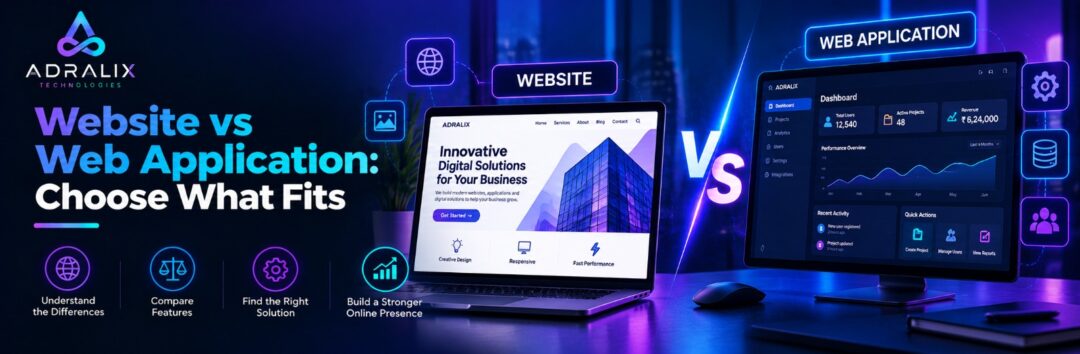
Website vs Web Application is an important distinction for businesses planning a new digital presence or product. A website primarily presents information and helps visitors understand a business, while a web application provides interactive functionality that allows users to complete tasks, manage information, or perform transactions.
The distinction is not absolute. Modern websites can include sophisticated features, and web applications often contain informational pages. The practical decision depends on what users need to accomplish and how much functionality the product requires.
Quick Answer: Website vs Web Application
A website typically focuses on presenting content, information, services, or products. A web application focuses more on interactive workflows, personalized experiences, data processing, or user-specific actions.
Key Facts
- A website can include forms, search, eCommerce, and interactive features.
- A web application typically supports more complex workflows or user tasks.
- Both can run in a browser and require suitable security, performance, and maintenance.
- Websites and web applications can share frontend, backend, database, and API technologies.
- The appropriate choice depends on functionality, users, integrations, and operating requirements.
- A website can evolve into a web application as business requirements expand.
The right decision is not about selecting the more advanced option. It is about avoiding unnecessary complexity while ensuring users can achieve their goals.
Website Development: When Is a Website Enough?
Website Development is often the right starting point when the main objective is to communicate information, establish credibility, showcase products or services, and generate enquiries.
Common website types include:
- Corporate websites: Present company information, services, expertise, and contact details.
- Service websites: Explain offerings and guide visitors toward an enquiry.
- Content websites: Publish articles, resources, announcements, or educational materials.
- Portfolio websites: Showcase projects, products, or creative work.
- eCommerce websites: Display products and allow customers to place orders.
A well-planned website should provide clear navigation, responsive layouts, accessible content, useful calls to action, and a structure that can be maintained over time.
It may also need a content management system, analytics, contact forms, payment functionality, search, or third-party integrations. These features do not automatically make the entire product a complex web application.
For many businesses, a responsive website with a suitable CMS is sufficient to support online visibility, enquiries, and routine content management.
Adralix’s Web Development Services cover corporate websites, eCommerce, CMS, and custom web solutions based on business requirements.
Web Application Development: When Do You Need More Functionality?
Web Application Development is appropriate when users need to interact with data, complete workflows, manage accounts, or use application-specific functionality through a browser.
Examples include:
- Customer and employee portals
- SaaS products
- Booking and reservation platforms
- Inventory management systems
- Business dashboards
- Online marketplaces
- Project management tools
- Workflow and approval systems
These solutions often require authentication, permissions, databases, APIs, business logic, integrations, and more extensive testing.
For example, a business website may explain how a booking service works and collect enquiries. A booking web application may also let users select available times, create accounts, make payments, manage appointments, and receive status updates.
The additional functionality changes the project scope, architecture, testing, and maintenance requirements.
Web applications often benefit from explicit planning around user roles, data ownership, integration behavior, error handling, and security. Adralix’s web development capabilities include web application development for interactive business workflows.
Website vs Web Application: Key Differences
Compare the two options against the requirements of your business rather than relying on the label alone.
| Consideration | Website | Web Application |
| Main purpose | Present information or services | Enable interactive tasks and workflows |
| User interaction | Often focused on browsing and enquiries | Often includes personalized or data-driven actions |
| Accounts | Optional | Frequently required, depending on use case |
| Data processing | May be limited or integrated | Often central to application behavior |
| Architecture | Can be relatively simple or highly complex | Often involves more application logic |
| Typical examples | Corporate site, blog, service pages | Customer portal, dashboard, SaaS platform |
| Maintenance | Content, software, security, and performance | Application logic, data, integrations, security, and updates |
There is overlap between these categories. eCommerce websites, for example, can contain complex application functionality. A company’s decision should therefore be based on required features and workflows rather than the name assigned to the project.
Custom Web Development: How to Choose the Right Solution
Custom Web Development can be relevant to both websites and web applications. It allows businesses to tailor functionality, design, workflows, and integrations to their actual requirements.
Before choosing, answer these questions:
- What should users accomplish? Reading information differs from managing complex transactions or workflows.
- Do users need accounts? Personalized information, permissions, and user-specific data may require application features.
- What systems need to connect? CRM, ERP, payment, inventory, and other integrations can affect architecture.
- How complex is the business logic? Rules, calculations, approvals, and automated workflows may require application development.
- How will the product evolve? Future features, users, data, and integration requirements should inform the design.
- What needs to be maintained? Consider content updates, infrastructure, dependencies, security, and ongoing support.
Website vs Web Application: A Practical Decision Guide
| If Your Main Goal Is… | Consider… |
| Explain your business and services | A corporate website |
| Publish articles or resources | A content-focused website |
| Generate leads and enquiries | A website with relevant forms and conversion paths |
| Sell products online | An eCommerce website or commerce application |
| Manage user-specific records | A web application |
| Automate multi-step workflows | A web application |
| Combine information and advanced functionality | A website with integrated application components |
Adralix’s portfolio includes Herbstrix and Saral Home, which can provide starting points for discussing eCommerce storefront requirements. For broader technology decisions, read Custom Software Development vs Off-the-Shelf Software.
The best solution is the simplest architecture that fully meets the requirements while leaving an appropriate path for future development.
Frequently Asked Questions About Websites and Web Applications
What is the main difference in Website vs Web Application?
Website vs Web Application mainly comes down to purpose and functionality. A website usually emphasizes presenting information, while a web application enables users to perform more interactive or data-driven tasks. However, the two can overlap.
When should a business choose Web Application Development?
Web Application Development is appropriate when users need accounts, personalized information, dashboards, workflows, data processing, or integration with other systems.
Does Website Development support eCommerce?
Yes. Website Development can include eCommerce functionality such as product catalogs, checkout, payments, order management, and inventory integrations. The complexity depends on the requirements.
When is Custom Web Development necessary?
Custom Web Development may be necessary when templates or standard platforms cannot adequately support the required workflows, functionality, design, or integrations.
Conclusion
Website vs Web Application is a decision about business purpose, user needs, functionality, and technical complexity. A website may be sufficient for information, services, and lead generation, while a web application is often more suitable for personalized tasks, data-driven workflows, and complex interactions.
The distinction is not rigid, and some digital products combine both approaches. Start by mapping the user journeys, required features, integrations, and long-term maintenance needs before choosing the architecture.
Adralix Technologies supports website and web application development through its published web engineering capabilities. The objective is to build the right digital solution for your requirements without introducing unnecessary complexity.