 Post by
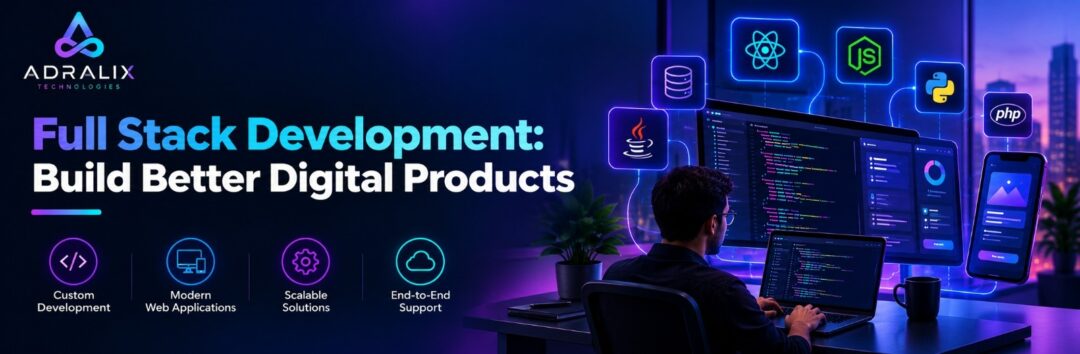
Full Stack Development brings the user-facing and server-side layers of an application together, including interfaces, application logic, APIs, databases, and integrations. It can help businesses build connected digital products without treating frontend and backend requirements as separate projects.
For organizations planning a website, SaaS platform, customer portal, or internal business application, full-stack development provides a way to coordinate the parts required to make a product work. However, it does not mean every project should rely on one developer handling everything. The right team structure depends on complexity, scope, and engineering needs.
Quick Answer: What Is Full Stack Development?
Full Stack Development covers multiple layers of an application, typically including frontend interfaces, backend logic, APIs, data storage, and integrations.
A full-stack development workflow considers how these layers work together, how information moves between them, and how the complete application can be tested, deployed, and maintained.
Key Facts About Full Stack Development
- Frontend development handles user-facing interfaces and interactions.
- Backend development processes requests, business logic, permissions, and data.
- APIs allow application components and external systems to communicate.
- Databases store and retrieve information required by the application.
- Full-stack developers work across more than one application layer.
- Full-stack development still depends on testing, security, deployment, and maintenance.
- Complex products may require dedicated specialists alongside full-stack engineers.
Full-stack does not mean using one specific technology stack. It describes the breadth of development responsibilities rather than a single framework or programming language.
Frontend and Backend Development: How Do the Layers Work Together?
Frontend and Backend Development have distinct responsibilities, but a product depends on their coordination.
The frontend presents the interface and captures user interactions. The backend processes requests, applies business rules, accesses data, and returns information to the frontend.
Consider a customer portal. Its frontend may display account details, forms, invoices, and dashboards. Its backend may authenticate users, retrieve records, apply permissions, and integrate with internal business systems.
| Layer | Main Responsibilities | Typical Components |
| Frontend | Interface, navigation, interactions | HTML, CSS, JavaScript, React |
| Backend | Business logic and request handling | Node.js, Python, PHP, Java |
| APIs | Communication between systems | Endpoints, requests, responses |
| Database | Information storage and retrieval | Relational and NoSQL databases |
| Deployment | Production environment and release | Hosting, configuration, monitoring |
These layers need a shared architecture. A change in the data model can affect the backend API and frontend display. An authentication change can affect the interface, backend permissions, and integration behavior.
Adralix’s published Frontend vs. Backend Development guide explains these responsibilities in greater detail.
Full Stack Development Services: What Should They Include?
Full Stack Development Services should address the connected requirements needed to build and support an application.
Depending on the project, the scope may include:
- Frontend implementation: Build interfaces, navigation, forms, and reusable components.
- Backend development: Implement business rules, APIs, permissions, and server-side functionality.
- Database design: Structure data and define how the application stores and retrieves it.
- API integrations: Connect services such as payment gateways, CRMs, or external platforms.
- UI/UX collaboration: Align implementation with user journeys, wireframes, and interface requirements.
- Testing: Validate individual components and complete application workflows.
- Deployment: Prepare the application for production and establish suitable monitoring.
- Maintenance: Resolve defects, update dependencies, and evolve functionality over time.
The extent of each service depends on whether the project is a new product, an extension of an existing application, or a modernization effort.
A full-stack engagement should establish the technology stack, deliverables, responsibilities, code ownership, testing expectations, deployment process, and post-launch support at the beginning.
Full Stack Development vs. Separate Specialists
Businesses often need to decide whether to use full-stack developers, dedicated frontend and backend specialists, or a combination of both.
| Consideration | Full-Stack Developers | Separate Specialists |
| Scope | Work across multiple layers | Focus on particular technical areas |
| Coordination | Can reduce handoffs for smaller features | Requires coordination across specialties |
| Expertise | Broad technical coverage | Potentially deeper specialized expertise |
| Best fit | Smaller products and integrated feature delivery | Complex systems and demanding technical requirements |
| Team structure | Flexible across layers | Clear ownership by discipline |
Neither model is automatically better. A smaller application may benefit from a full-stack engineer who can build features across the product. A larger platform may need specialists for frontend performance, backend architecture, data engineering, infrastructure, security, or complex integrations.
The important question is how to organize the team around the product’s risks, workload, and roadmap.
When Does a Business Need Full Stack Development?
Full Stack Development can be particularly useful when the application requires coordinated work across the interface, backend, and data layers.
Consider it when your business is:
- Building a new product: Frontend and backend requirements need to evolve together.
- Creating a customer portal: Interfaces, authentication, data, and workflows must operate as one system.
- Developing an MVP: A broad engineering skill set can help implement a focused initial version.
- Extending an existing application: New features require changes across multiple layers.
- Integrating business tools: Data must move between the application and external systems.
- Working with limited team capacity: Cross-layer skills may help cover a broader set of tasks.
Adralix’s published technology capabilities include MERN Development Services and MEAN Development Services, which combine frontend and backend technologies within established full-stack architectures.
Its broader Web Development Services cover websites, web applications, eCommerce, CMS, and related implementation needs.
Frequently Asked Questions About Full Stack Development
What is Full Stack Development used for?
Full Stack Development is used to build applications involving interfaces, backend logic, APIs, databases, and integrations. It can support websites, portals, dashboards, SaaS products, and business applications.
What do Full Stack Development Services include?
Full Stack Development Services can include frontend, backend, database, API, integration, testing, deployment, and maintenance work, depending on the project scope.
Should I hire a Full Stack Developer or separate specialists?
A Full Stack Developer may suit a smaller or tightly scoped product. Separate specialists can be more appropriate when the system requires deeper expertise across complex frontend, backend, data, security, or infrastructure areas.
Is Full Stack Development the same as web development?
No. Web development includes creating websites and web applications, while Full Stack Development specifically refers to work across multiple application layers. A web development project can involve separate frontend and backend specialists instead.
Conclusion
Full Stack Development connects frontend interfaces, backend logic, APIs, data, and integrations into a coordinated application. It can be useful when businesses need a connected delivery approach across multiple layers, but the right staffing model depends on the project’s complexity and technical risks.
Adralix Technologies provides web development and related engineering capabilities, including its MERN and MEAN technology offerings. Before choosing a full-stack approach, define your product requirements, integration needs, team structure, quality expectations, and maintenance plans.
The goal is not simply to cover more technologies. It is to make the complete application work as a reliable, maintainable product.