 Post by
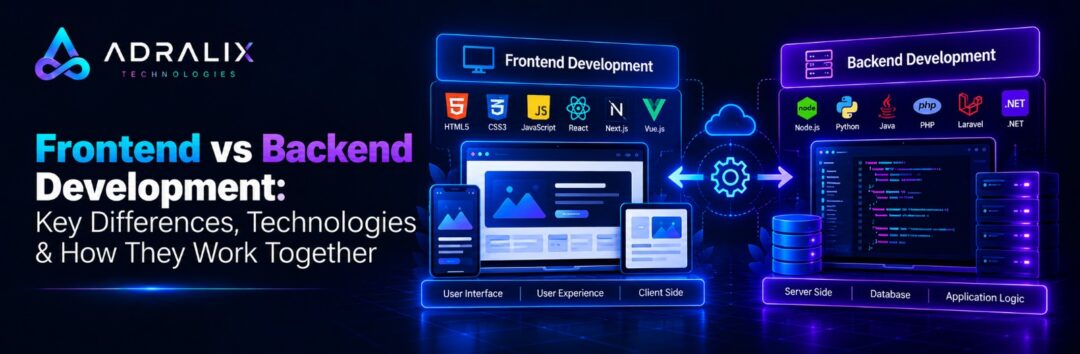
Frontend vs Backend Development describes two essential layers of modern web applications. Frontend development creates the interface users see and interact with, while backend development manages application logic, data, APIs, authentication, and the systems that power those experiences.
For businesses building websites, SaaS platforms, eCommerce stores, portals, or custom applications, understanding Frontend vs Backend Development helps clarify technical requirements, team responsibilities, technology choices, performance expectations, and development priorities.
The two layers serve different purposes, but neither works effectively in isolation. A reliable digital product depends on how well its frontend, backend, APIs, databases, and infrastructure work together.
Quick Answer: What Is the Difference Between Frontend and Backend Development?
Frontend development, also called client-side development, focuses on the part of a website or application that users see and interact with. It includes layouts, navigation, forms, buttons, animations, responsiveness, accessibility, and other user-facing functionality.
Backend development, also called server-side development, manages the systems behind the interface. It processes requests, applies business logic, handles authentication, communicates with databases, manages APIs, and connects the application with external services.
The MDN guide to server-side programming explains that client-side code primarily controls presentation and browser behavior, while server-side code processes requests, works with databases, validates data, and determines what information is returned to the client.
Frontend vs Backend Development at a Glance
| Frontend Development | Backend Development |
| User-facing layer | Server-side layer |
| Runs primarily in the browser | Runs primarily on servers |
| Focuses on interface and interaction | Focuses on logic, data, and processing |
| Uses HTML, CSS, JavaScript, and frameworks | Uses programming languages, frameworks, APIs, and databases |
| Handles user interactions | Handles requests and responses |
| Emphasizes usability and responsiveness | Emphasizes reliability, security, and scalability |
What Does Frontend Development Do?
Frontend Development turns product requirements and designs into interactive browser experiences.
A frontend team may be responsible for:
- Building page and application layouts
- Creating reusable UI components
- Implementing navigation and interactions
- Making interfaces responsive
- Supporting accessibility
- Connecting interfaces to APIs
- Handling client-side validation
- Optimizing browser-side performance
The foundational technologies are HTML, CSS, and JavaScript. Modern applications may also use React, Next.js, Angular, Vue.js, and TypeScript.
The scale of JavaScript usage illustrates how central frontend technologies have become. According to the 2025 Web Almanac by HTTP Archive, 98.1% of web pages make at least one request for a JavaScript file. The same report shows that JavaScript is an active performance cost because browsers must both download and execute it.
That makes frontend architecture, asset optimization, code splitting, rendering strategy, and browser performance important considerations in Frontend vs Backend Development.
Read More: Software Development Process: 8 Steps From Idea to Launch
Popular Frontend Technologies
| Technology | Common Use |
| HTML | Page structure |
| CSS | Layout and presentation |
| JavaScript | Interactivity and application behavior |
| React | Component-based interfaces |
| Next.js | React-based websites and web applications |
| TypeScript | Typed JavaScript development |
React has a significant presence across the modern web. W3Techs currently reports React on 6.0% of all websites, equivalent to 7.9% of websites whose JavaScript library is known.
Next.js is also widely used. W3Techs currently reports Next.js on 3.4% of all websites and 4.5% of websites whose JavaScript library is known.
Businesses looking for React expertise can explore Adralix’s ReactJS Development Services, while projects requiring a React-based full-stack framework can consider its NextJS Development Services.
What Does Backend Development Do?
Backend Development manages the logic and systems that power an application’s visible interface.
When a user logs in, searches for a product, creates an account, submits a form, places an order, or opens a dashboard, backend systems typically process the request and determine what should happen.
Backend responsibilities can include:
- Business logic
- API development
- Database operations
- Authentication and authorization
- Payment processing
- Data validation
- Third-party integrations
- Server-side rendering
- Logging and monitoring
- Application performance
The MDN server-side development guide explains that server-side code can retrieve and store data, validate requests, manage permissions, and return the appropriate response to the browser.
Popular Backend Technologies
| Technology | Common Use |
| Node.js | Server-side JavaScript |
| Python | APIs, applications, data-driven systems |
| PHP | Web applications and server-side development |
| Laravel | PHP application development |
| Java | Enterprise and backend applications |
| SQL / NoSQL | Data storage and retrieval |
Node.js also has substantial adoption across the web. W3Techs currently reports Node.js on 7.2% of websites whose web server technology is known.
For businesses requiring Node.js expertise, Adralix provides NodeJS Development Services covering backend applications, APIs, integrations, and scalable server-side systems.
Read More: Web Development Company: Services, Process, Cost & How to Choose
Frontend vs Backend Development: Key Differences
The clearest way to understand Frontend vs Backend Development is to compare their responsibilities across the application.
| Area | Frontend | Backend |
| Primary focus | User experience | Application functionality |
| Execution | Browser | Server |
| Main technologies | HTML, CSS, JavaScript, React, Next.js | Node.js, Python, PHP, Laravel, Java |
| Data | Displays and submits information | Stores, processes, and retrieves information |
| Performance | Rendering and browser interaction | Processing, APIs, and databases |
| Security | Client-side validation and secure flows | Authentication, authorization, data protection |
| Scalability | Rendering and asset delivery | Infrastructure, databases, caching, concurrency |
| Output | Interface and interaction | Data and application response |
Frontend vs Backend Development is therefore not simply a comparison of programming languages. It is a distinction between different application layers and engineering responsibilities.
How Do Frontend and Backend Work Together?
Modern web applications typically depend on communication between the two layers.
A simplified flow looks like:
User Action → Frontend Request → API → Backend Logic → Database / Service → Backend Response → Frontend Update
For an eCommerce application, for example:
Frontend Handles
- Product search
- Filters
- Product pages
- Shopping cart
- Checkout interface
- Order status
Backend Handles
- Product information
- Inventory
- Pricing rules
- Customer accounts
- Payment processing
- Order creation
- Database operations
The MDN client-server overview explains how browsers send HTTP requests to servers and how server-side systems process those requests before returning responses.
This is why frontend and backend development should not be treated as isolated disciplines. The visible experience depends on the systems operating behind it.
Read More: How to Choose the Right Technology Stack for Your Web Application
Frontend vs Backend Technologies: How Should Businesses Choose?
Technology selection should follow application requirements.
Businesses should evaluate:
- Application type
- User experience requirements
- Data complexity
- Integration requirements
- Expected traffic
- Security needs
- Existing team expertise
- Scalability requirements
- Maintenance needs
- Time-to-market expectations
This connects directly to Adralix’s existing article, How to Choose the Right Technology Stack for Your Web Application, which explains why technology decisions should begin with business and product requirements instead of simply following popular frameworks.
The 2025 Stack Overflow Developer Survey collected 49,000+ responses and continues to show strong interest in modern web technologies. Its AI section also reports that 84% of respondents were using or planning to use AI tools in development, while 51% of professional developers reported using AI tools daily. Stack Overflow Developer Survey 2025
AI-assisted development changes how teams write and review software, but it does not remove the need for architecture, testing, security, and human oversight.
Frontend vs Backend Development: Statistics That Matter
Current technology adoption and web-performance data provide useful context for Frontend vs Backend Development.
| Statistic | What It Shows | Source |
| 98.1% of pages | Make at least one JavaScript request | 2025 Web Almanac |
| 6.0% of all websites | Use React | W3Techs |
| 3.4% of all websites | Use Next.js | W3Techs |
| 7.2% of websites with known web-server technology | Use Node.js | W3Techs |
| 84% | Stack Overflow respondents using or planning to use AI tools in development | Stack Overflow 2025 |
| 51% | Professional developers using AI tools daily | Stack Overflow 2025 |
These figures show the scale of the technologies commonly used across frontend and backend development, but adoption alone should not determine the stack for a particular product.
Frontend vs Backend Development for Different Applications
The balance between frontend and backend work depends heavily on the product.
| Application | Frontend Priorities | Backend Priorities |
| Corporate Website | UX, content, SEO, responsiveness | CMS, forms, integrations |
| eCommerce | Product discovery and checkout | Inventory, orders, payments |
| SaaS Platform | Dashboards and workflows | APIs, authentication, data |
| Customer Portal | Navigation and accessibility | Accounts, permissions, security |
| Marketplace | Search, profiles, transactions | Matching, payments, business logic |
| Real-Time Application | Live interface updates | Events, concurrency, messaging |
A corporate website may emphasize interface, content, performance, and SEO, while an enterprise SaaS platform may require extensive backend architecture, authentication, databases, APIs, and integrations.
The Frontend vs Backend Development balance should therefore be determined by the product’s actual requirements.
Full Stack Development: Where Frontend and Backend Meet
Full Stack Development combines frontend and backend capabilities within a broader engineering workflow.
A full-stack developer may work across:
- User interfaces
- APIs
- Business logic
- Databases
- Authentication
- Integrations
- Deployment
- Testing
Full-stack does not necessarily mean one person should perform every technical role. Larger products often have frontend and backend specialists working alongside designers, QA engineers, DevOps professionals, architects, and product teams.
Adralix’s Full Stack Development Services cover interconnected frontend, backend, API, database, integration, testing, and application requirements.
For businesses considering a unified JavaScript stack, Adralix also provides MERN Development Services and MEAN Development Services.
Frontend vs Backend Development: Security Considerations
Security is shared across both layers, but the controls differ.
Frontend Security
- Secure authentication flows
- Input handling
- Safe browser-side data practices
- Client-side validation
- Protection against client-side vulnerabilities
Backend Security
- Authentication
- Authorization
- API security
- Database access control
- Encryption
- Session management
- Secure server configuration
NIST recommends integrating secure development practices into existing software development approaches rather than treating security as a final-stage activity. The NIST Secure Software Development Framework provides practices that can be incorporated throughout the software development lifecycle.
In Frontend vs Backend Development, security therefore needs to be viewed as a system-wide responsibility.
Frontend vs Backend Development: Performance Considerations
Performance problems can originate on either side of the application.
Frontend Performance Issues
- Large images
- Excessive JavaScript
- Unoptimized assets
- Slow rendering
- Inefficient client-side operations
Backend Performance Issues
- Slow database queries
- Inefficient APIs
- High server latency
- Poor caching
- Infrastructure bottlenecks
Google’s current Core Web Vitals guidance identifies LCP of 2.5 seconds or less, INP below 200 milliseconds, and CLS below 0.1 as the thresholds associated with good user experience.
The 2025 Web Almanac also shows why frontend optimization matters: JavaScript requires both network transfer and browser execution, meaning inefficient frontend code can add to the performance workload.
A fast digital experience therefore depends on more than frontend implementation. API response times, database performance, backend processing, infrastructure, caching, and network behavior can all affect the final user experience.
How Should a Business Decide Where It Needs More Expertise?
Businesses generally do not need to choose frontend or backend permanently. Instead, identify the current engineering bottleneck.
Prioritize Frontend Expertise When:
- The interface is outdated
- User journeys are difficult
- The application is not responsive
- Frontend performance is poor
- UI components are difficult to maintain
- A legacy frontend needs modernization
Prioritize Backend Expertise When:
- APIs are slow or unreliable
- Database operations are becoming bottlenecks
- Integrations are difficult to maintain
- Authentication needs improvement
- Traffic or data volumes are increasing
- Business logic is becoming difficult to manage
Consider Full Stack Expertise When:
- You are launching a new digital product
- Frontend and backend require coordinated development
- Internal engineering capacity is limited
- The project requires work across multiple application layers
This makes Frontend vs Backend Development a business-capability decision rather than simply a technology decision.
Frequently Asked Questions
What is frontend development?
Frontend development creates the browser-facing part of a website or application. It includes structure, styling, interaction, responsiveness, accessibility, and client-side functionality.
What is backend development?
Backend development manages server-side logic, APIs, databases, authentication, integrations, and data processing.
What is the main difference between frontend and backend development?
Frontend development focuses on what users see and interact with, while backend development manages the logic, data, APIs, and systems behind that experience.
Is React frontend or backend?
React is a JavaScript library primarily used to build user interfaces and frontend applications. W3Techs currently tracks React on 6.0% of all websites.
Is Node.js frontend or backend?
Node.js is a JavaScript runtime commonly used for server-side and backend development. W3Techs currently reports Node.js on 7.2% of websites whose web-server technology is known.
Conclusion
Frontend vs Backend Development represents two interconnected layers of modern application engineering.
Frontend development creates the digital experience users see and interact with. Backend development manages application logic, APIs, databases, authentication, integrations, and data processing.
The distinction is useful, but businesses should not treat frontend and backend as competing choices. The right architecture connects both around a common product objective.
When planning a new website, SaaS product, eCommerce platform, customer portal, or custom application, start with business requirements. Then determine which frontend, backend, or full-stack capabilities are necessary.
Adralix Technologies brings together frontend, backend, full-stack, UI/UX, QA, and related engineering capabilities to help businesses build, modernize, and scale digital products around their actual requirements.
The goal is not to choose between frontend and backend. It is to make both work together reliably, securely, and efficiently.