 Post by
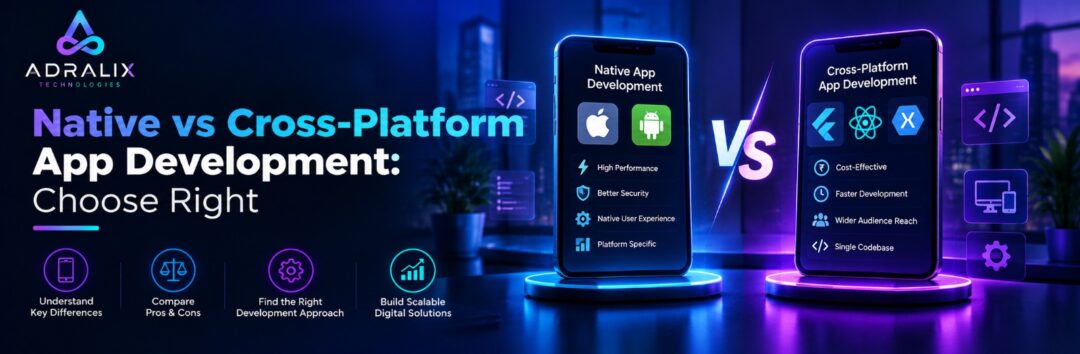
Native vs Cross-Platform App Development is an important decision for businesses planning an Android or iOS application. The approach influences how an app is built, how code is shared, how platform features are accessed, and how the product is tested and maintained.
There is no universal winner. Native development can provide direct access to platform-specific capabilities, while cross-platform development can share substantial parts of the codebase across supported platforms. The right choice depends on your product, users, functionality, timeline, engineering resources, and long-term roadmap.
Quick Answer: Native vs Cross-Platform App Development
Native app development builds applications specifically for a platform, typically using its preferred languages and tools. Cross-platform app development uses a framework that allows teams to share much of the application code across platforms such as Android and iOS.
Key Facts
- Native apps are developed for a specific operating system.
- Cross-platform frameworks can share code between supported platforms.
- Both approaches can require platform-specific implementation and testing.
- Backend APIs and business logic may be shared regardless of the mobile approach.
- Development cost depends on scope, complexity, team expertise, testing, and maintenance, not only code reuse.
- App quality depends on architecture, implementation, design, testing, and ongoing support.
Before choosing, define what the app must accomplish and which platform-specific capabilities it needs.
Native App Development: When Does It Make Sense?
Native App Development uses technologies designed for a specific operating system. Android apps commonly use Kotlin, while iOS apps may use Swift and Apple’s development tools.
A native approach can be useful when the application requires extensive platform integration, specialized device capabilities, or highly tailored interactions.
Consider native development when your product depends on:
- Platform-specific features: Deep use of operating system capabilities.
- Specialized interactions: Interfaces that need close alignment with platform conventions.
- Complex device integrations: Features involving hardware or system-level functionality.
- Independent release roadmaps: Android and iOS products that may evolve differently.
- Platform-specific optimization: Detailed control over how each application behaves.
However, native development can mean maintaining separate platform implementations. That may increase duplicated work when both applications share similar features, although the actual effort depends on the architecture and team.
Native development is not automatically faster or more expensive. A straightforward native application can be simpler than a complicated cross-platform product with many plugins, integrations, and platform-specific exceptions.
The decision should be based on product requirements rather than a blanket belief that native apps are always superior.
Cross-Platform App Development: When Can It Help?
Cross-Platform App Development allows teams to share substantial application code across Android and iOS while adapting interfaces or functionality where each platform requires it.
Frameworks such as Flutter and React Native are common options. They can help businesses reduce duplicated implementation when the product’s requirements fit the framework well.
A cross-platform approach may suit businesses that want to:
- Build for Android and iOS with substantial shared code.
- Keep core business logic and product behavior aligned.
- Maintain a common feature roadmap across platforms.
- Use engineering resources efficiently.
- Create an MVP before investing in more platform-specific work.
Cross-platform development still requires careful testing. Screen sizes, permissions, notifications, navigation, platform APIs, and third-party dependencies can behave differently across devices and operating systems.
Flutter App Development
Flutter App Development uses Google’s Flutter framework to build applications for multiple platforms from a shared codebase. It may be suitable when a team wants consistent UI implementation and a common development workflow.
React Native is another option, especially when the team has relevant React and JavaScript experience. The right framework depends on product requirements, existing skills, platform integrations, and maintenance expectations.
Adralix offers Flutter Development Services and React Native Development Services for businesses evaluating cross-platform mobile development.
Native vs Cross-Platform App Development: Comparison Table
The practical trade-offs become clearer when both approaches are evaluated against the same criteria.
| Decision Factor | Native Development | Cross-Platform Development |
| Codebase | Separate platform implementations | Shared code for much of the app |
| Platform access | Direct platform-specific tooling | Framework and plugin capabilities, with native code where needed |
| UI behavior | Detailed platform-level control | Shared UI approach with platform adaptation |
| Team requirements | Potentially separate platform expertise | Framework expertise plus platform knowledge |
| Maintenance | Platform-specific updates | Shared code and platform-specific upkeep |
| Best fit | Specialized platform requirements | Apps suited to shared implementation |
The table is a decision aid, not a guarantee about delivery speed or cost. A poorly planned native app can be difficult to maintain, while a well-structured cross-platform app can still require native expertise for advanced features.
How to Choose the Right App Development Approach
Start with the user experience and product roadmap rather than choosing a framework first.
- Identify your audience: Determine whether Android, iOS, or both platforms are essential at launch.
- Define must-have features: List device capabilities, integrations, offline behavior, notifications, and other requirements.
- Assess performance needs: Identify any highly specialized processing or interaction requirements.
- Review team expertise: Consider existing developers, tooling, and long-term hiring or maintenance.
- Estimate the complete lifecycle: Include design, development, QA, release, updates, and support.
- Prototype risky features: Test difficult integrations or platform-specific behaviors before finalizing architecture.
Adralix’s App Development Services cover product planning, design, development, testing, deployment, and support. Its published capabilities include Flutter, React Native, Kotlin, and Swift.
For businesses still comparing implementation options, the existing Adralix article on choosing the right technology stack for a web application provides a broader framework for making technology decisions.
Frequently Asked Questions About App Development
What is the difference between Native App Development and Cross-Platform App Development?
Native App Development builds an app specifically for one platform. Cross-Platform App Development shares much of the implementation across supported platforms, although platform-specific code may still be required.
Is Flutter App Development a good choice for every business?
No. Flutter can be suitable when shared UI and code are beneficial, but the decision depends on integrations, platform-specific features, existing skills, performance requirements, and maintenance.
Does cross-platform development always cost less?
Not necessarily. Shared code may reduce duplicated implementation, but cost also depends on app complexity, integrations, testing, platform-specific work, and ongoing support.
Should I build Android or iOS first?
Choose based on your target audience, market, product use cases, business goals, and validation strategy. Some businesses may launch on one platform first, while others need both at the beginning.
Conclusion
Native vs Cross-Platform App Development is a product and engineering decision, not simply a choice between programming languages. Native development can suit specialized platform needs, while cross-platform development can help share implementation across Android and iOS.
The best approach depends on the product’s functionality, user expectations, integrations, team expertise, and long-term ownership. Adralix Technologies supports native and cross-platform development through its mobile app capabilities, including Flutter, React Native, Kotlin, and Swift.
Define the requirements first, evaluate the trade-offs, and choose the architecture that supports your product from launch through future improvements.