 Post by
Choosing the right software is about more than price. Your decision can affect how employees work, how customers interact with your business, how systems communicate, and how quickly you can respond to change. That is why custom software development vs off-the-shelf software is a strategic decision, not simply a procurement decision.
Off-the-shelf software can be ideal when a mature product already solves a standardized problem. Custom software development becomes more attractive when you have unique workflows, complex integrations, specialized requirements, or technology that can help differentiate your business.
There is also a third option: combine the two.
Gartner’s application-strategy research has moved beyond a simple build-or-buy model toward “buy, build, and blend.” Also, research similarly argues for evaluating whether businesses should customize, compose, or generate applications rather than treating the choice as purely binary. (gartner.com)
So, what should your business choose?
The answer depends on your business requirements, budget, timeline, integrations, scalability needs, internal capabilities, and long-term technology strategy.
What Is Custom Software Development?
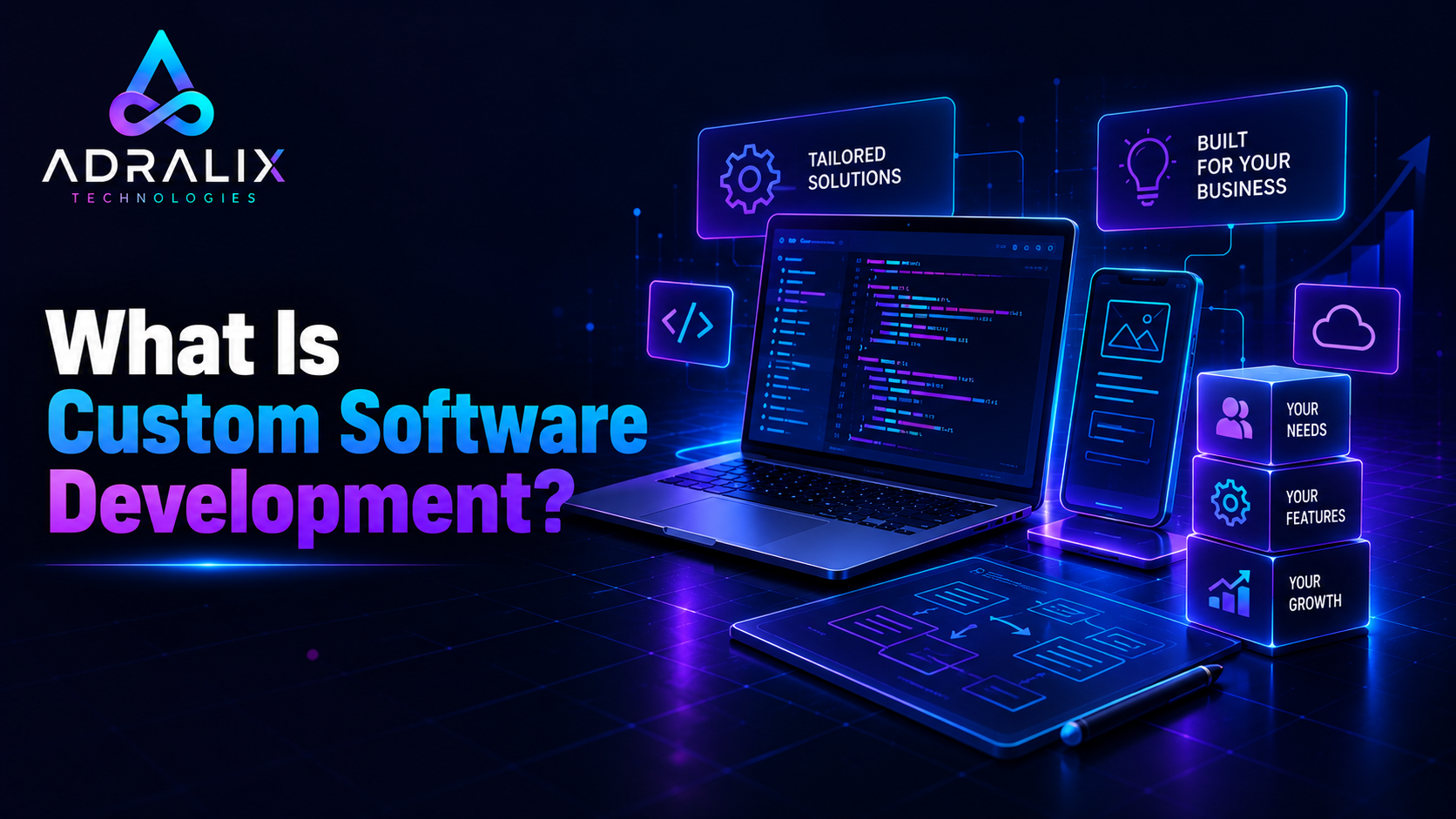
Custom Software Development means creating software specifically for a business, product, process, or user group. Instead of adapting your operations to an existing platform, the software is designed around your requirements.
Common examples
- Business applications
- Customer portals
- SaaS products
- Enterprise platforms
- Custom dashboards
- Workflow systems
- Industry-specific software
- Mobile applications
- API-driven products
- Automation systems
Main advantage
Flexibility.
Custom software can be designed around your:
- Workflows
- User roles
- Business rules
- Data structures
- Integrations
- Security requirements
- Reporting needs
- Product roadmap
The trade-off is greater responsibility for development, testing, infrastructure, maintenance, security, and future enhancements.
What Is Off-the-Shelf Software?
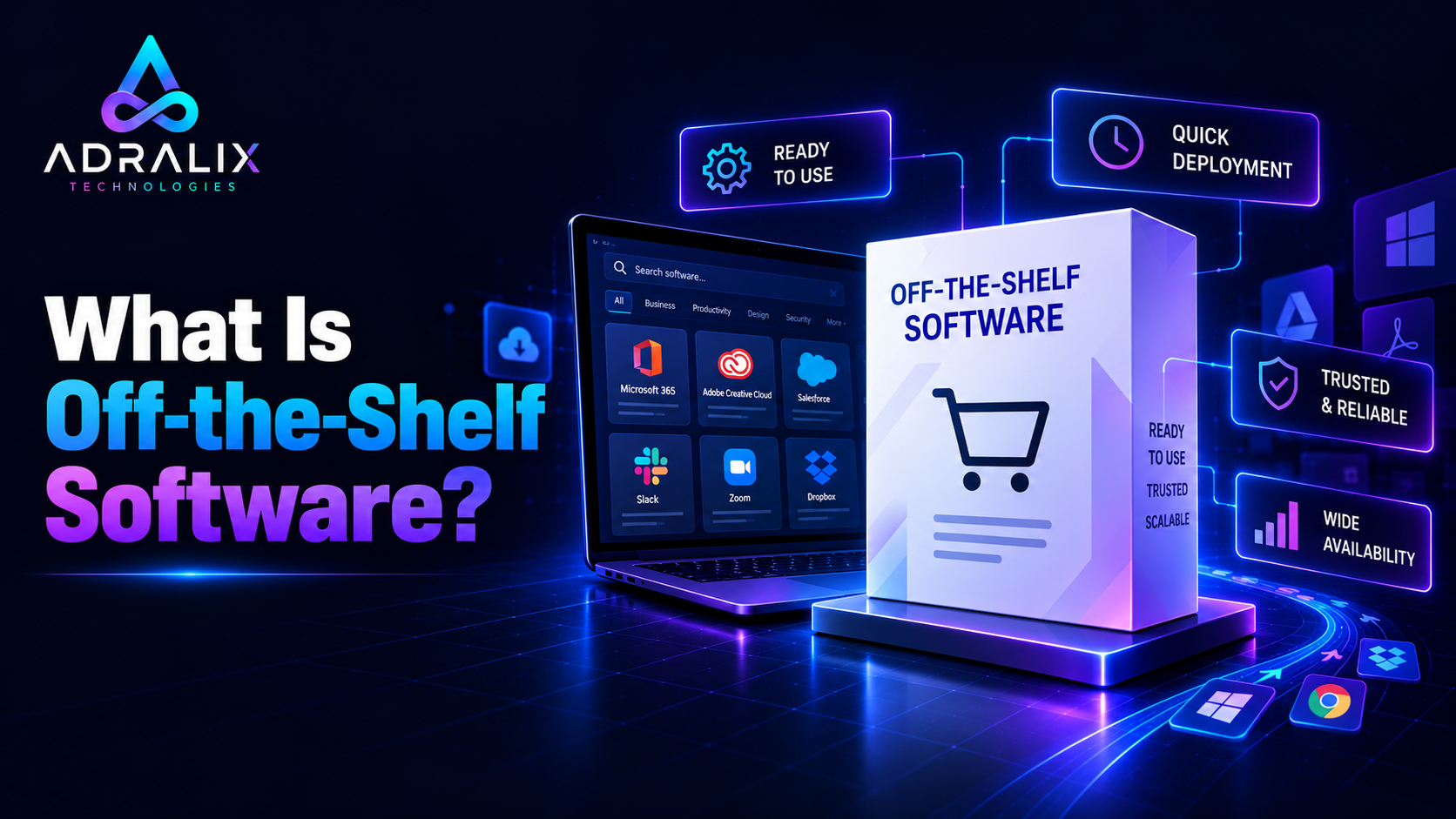
Off-the-Shelf Software is a pre-built product designed for a broad market.
Examples include:
- CRM platforms
- Accounting software
- HR systems
- Project-management tools
- Marketing platforms
- Helpdesk software
- Collaboration tools
- eCommerce platforms
- Analytics software
The main advantage is simple:
The product already exists.
You can configure it, implement it, connect your systems, train users, and start using it without building the entire platform from scratch.
For standardized requirements, that can be the most practical option.
Custom Software vs Off-the-Shelf Software: The Core Difference
Think about it this way:
Off-the-shelf software asks your business to fit the product.
Custom software is built to fit the business.
Neither approach is automatically better.
The key question is:
Is the problem standardized or is it strategically important enough to justify customization?
This matters because software can become more than an operational tool.
McKinsey found that nearly 70% of top economic performers use proprietary software to differentiate themselves, compared with about half of their peers. (mckinsey.com)
That does not mean every company should build software.
It means businesses should identify where software creates real strategic value.
Custom Software Development vs Off-the-Shelf Software: 10 Factors to Compare
- Business Fit
Off-the-shelf products work best when your processes are common. Custom software becomes more useful when your workflows are unusual.
For example, a business may have:
- Complex approval chains
- Specialized pricing rules
- Multiple user roles
- Industry-specific workflows
- Several connected systems
If employees need constant workarounds to make a packaged product fit, the business may have outgrown it.
Best fit:
Standard process → Off-the-shelf
Unique process → Custom
- Customization
Off-the-shelf products often provide configuration options, plugins, extensions, and integrations. But customization remains limited by the platform.
Custom software offers much greater control over:
- Features
- Workflows
- User journeys
- Business logic
- Interfaces
- Data structures
- Integrations
- Reporting
- Automation
The important question is not whether you can customize.
It is whether customization creates enough business value to justify the investment.
- Upfront Cost
Off-the-shelf software usually has a lower initial barrier.
Custom development typically requires investment in:
Discovery → Architecture → Design → Development → Testing → Deployment
But the initial price does not tell the whole story.
Off-the-shelf costs may include
- Licenses
- Subscriptions
- Implementation
- Customization
- Integrations
- Additional users
- Premium features
- Support
- Future migration
Custom software costs may include
- Discovery
- Design
- Development
- Testing
- Infrastructure
- Security
- Maintenance
- Support
- Future enhancements
The better metric is total cost of ownership, not just the initial invoice.
- Implementation Time
Off-the-shelf software generally wins on speed.
If an established platform already solves your problem, implementation can begin quickly.
Custom software takes longer because it needs to be:
Planned → Designed → Built → Tested → Deployed
But fast implementation does not always mean faster business value.
A product that launches quickly but forces years of workarounds may be more expensive in the long run.
Ask:
“Which option gets us to the right outcome faster?”
- Integration Requirements
Modern businesses rarely operate from one system.
A typical environment might look like:
CRM → ERP → Website → Mobile App → Payments → Inventory → Analytics
This makes software integration a major consideration.
Off-the-shelf platforms may offer:
- APIs
- Native connectors
- Marketplace integrations
- Third-party apps
These can make integration easier.
But highly specialized environments may require custom APIs, middleware, data synchronization, or additional tools.
When API integration is central to the product, custom development may provide more control.
- Scalability
Do not evaluate software only against today’s requirements.
Consider:
- More users
- More transactions
- More data
- More products
- More locations
- More integrations
- New workflows
- New customer segments
An established SaaS product may already have excellent infrastructure for large-scale usage.
Custom software may be preferable when growth introduces requirements that packaged systems cannot accommodate effectively.
Your product roadmap should be part of the decision from day one.
- Vendor Lock-In
With commercial software, the vendor typically controls:
- Pricing
- Product roadmap
- Licensing
- Feature availability
- Upgrade cycles
- Integration policies
That can be perfectly reasonable when the vendor is reliable and the product meets your needs.
But dependence becomes a concern when your strategic workflow depends on features the vendor does not plan to support.
Forrester highlights vendor roadmaps, licensing changes, and customization debt as important considerations in packaged-software decisions. (forrester.com)
- Maintenance and Long-Term Costs
Custom software requires ongoing engineering.
That may include:
- Bug fixes
- Security updates
- Dependency updates
- Performance optimization
- Monitoring
- New features
- Testing
But off-the-shelf software also has ongoing costs.
These can include:
- Subscription fees
- User licenses
- Premium modules
- Paid integrations
- Consulting
- Customization
- Training
- Migration costs
That is why long-term cost matters more than the starting price.
- Security and Compliance
Security can support either decision.
A mature commercial platform may already provide significant investment in:
- Infrastructure
- Monitoring
- Authentication
- Access management
- Security updates
- Compliance controls
But organizations with highly specific security requirements, data policies, or compliance obligations may need more control over the architecture.
Neither option is automatically safer.
CISA guidance recommends evaluating software suppliers and third-party software risks as part of procurement and security practices. (cisa.gov)
- Competitive Advantage
This may be the most strategic factor.
Ask:
Does the software simply support the business, or does it help the business compete?
A standard accounting platform probably will not differentiate you.
A proprietary:
- Pricing engine
- Customer platform
- Logistics workflow
- Recommendation system
- SaaS product
- Operational platform
might.
That is where custom development can become a strategic investment.
Custom Software vs Off-the-Shelf Software Cost: What Should You Compare?
The common mistake is comparing:
Monthly subscription
with
Custom development cost
Those numbers are not directly comparable.
Instead, compare the full lifecycle.
Off-the-Shelf
License + implementation + customization + integrations + support + future migration
Custom
Discovery + development + infrastructure + maintenance + support + future development
Then ask:
What will this software cost, and what value will it create, over the next three to five years?
Gartner’s application strategy research supports this broader way of thinking by encouraging organizations to evaluate where they should buy, build, and blend capabilities. (gartner.com)
When Should a Business Choose Custom Software?
Custom software becomes more compelling when several of these conditions apply.
Your Workflow Is Unique
Your business operates differently from the standard processes supported by packaged software.
Existing Tools Create Friction
Employees depend on:
- Spreadsheets
- Duplicate data entry
- Manual reconciliation
- Multiple disconnected systems
- Workarounds
Integrations Are Strategic
Your solution depends on connecting several business systems.
Software Creates Differentiation
Your customer experience, workflow, or proprietary process gives you an advantage.
You Need Greater Control
You need more control over functionality, architecture, data, or the product roadmap.
Inefficiency Is Expensive
Manual processes and software limitations are costing significant time or money.
When Is Off-the-Shelf Software the Better Choice?
Buying is often the better option when:
The Problem Is Standard
A mature product already solves the problem effectively.
Speed Matters
You need to implement a solution quickly.
Requirements Are Stable
Your processes fit comfortably within the product’s existing capabilities.
Customization Is Limited
You only need configuration rather than bespoke functionality.
The Vendor Ecosystem Is Strong
You can benefit from integrations, support, updates, documentation, and a mature partner ecosystem.
Internal Engineering Resources Are Limited
You do not want long-term responsibility for building and maintaining a custom system.
What About a Hybrid Approach?
This is where build vs buy software becomes more nuanced.
You can:
Buy what is standard.
Customize what is distinctive.
Build what creates differentiation.
For example, a business could:
- Buy a CRM
- Use commercial accounting software
- Use an established eCommerce platform
- Build a custom customer portal
- Develop proprietary workflows
- Connect everything with APIs
Gartner describes this as a buy, build, and blend approach. (gartner.com)
The principle is simple:
Don’t rebuild commodity functionality. Don’t compromise on technology that makes your business different.
Where Adralix Technologies Fits
Once a business decides that some part of its technology environment needs to be custom-built, the next challenge is execution.
A custom product may require:
UI/UX → Frontend → Backend → APIs → Database → QA → Deployment
Adralix Technologies works across web development, mobile app development, eCommerce, CMS, frontend and backend development, full-stack engineering, UI/UX, QA, and IT staff augmentation.
That allows businesses to engage around the complete product or around specific technical requirements.
For example, a business may already have a strong internal engineering team but need additional frontend expertise.
Another may have an existing eCommerce or CMS platform but require a custom customer portal.
A third may need an entire web or mobile application developed from the ground up.
The right engagement should follow the product requirements not the other way around.
A Practical Build vs Buy Decision Framework
Use these questions to compare the options:
| Factor | Off-the-Shelf | Custom |
| Standard workflow | Strong fit | Often unnecessary |
| Unique workflow | May require workarounds | Strong fit |
| Fast implementation | Strong fit | Usually slower |
| Deep customization | Limited | Strong fit |
| Complex integrations | Depends on ecosystem | Greater control |
| Competitive differentiation | Usually limited | Strong potential |
| Long-term control | Lower | Higher |
| Internal engineering needed | Lower | Higher |
| Initial investment | Usually lower | Usually higher |
| Long-term TCO | Must be evaluated | Must be evaluated |
| Vendor dependency | Higher | Usually lower |
| Business-specific roadmap | Vendor-driven | Business-driven |
Do not treat this as a scorecard with an automatic winner.
Identify the three or four factors that matter most to your business.
10 Questions to Ask Before Choosing
- What business problem are we solving?
Start with the desired outcome.
- Is the problem standardized or unique?
This often reveals the likely direction.
- How much customization do we actually need?
Avoid building an entire system for a small customization requirement.
- Which integrations are essential?
List every important system that needs to communicate with the solution.
- What happens as the business grows?
Consider users, data, transactions, products, locations, and workflows.
- What will the solution cost over three to five years?
Look beyond the first invoice.
- How much vendor dependency can we accept?
Consider pricing, roadmap control, licensing, and data portability.
- Who will maintain the software?
Custom systems need a long-term ownership plan.
- Where does software create competitive value?
Build around the parts that actually differentiate the business.
- Can we buy the standard layer and build the strategic layer?
This question often uncovers the strongest hybrid solution.
Custom Software vs Off-the-Shelf: Which Is Right for Your Business?
There is no universal winner.
Choose Off-the-Shelf When:
- Your requirements are standardized
- Speed is important
- A mature product already exists
- Deep customization is unnecessary
Choose Custom When:
- Your workflows are unique
- Integrations are complex
- Existing tools create significant friction
- Software can create differentiation
- You need greater control
Consider Hybrid When:
- You need the speed of commercial software
- You want custom capabilities around strategic workflows
- You do not need to build everything from scratch
This is increasingly relevant as application strategy evolves beyond the traditional binary choice. Gartner’s research emphasizes buy, build, and blend, while Forrester’s 2026 perspective adds customize, compose, or generate to the conversation.
How Adralix Technologies Can Support the Custom Development Journey
Once you’ve decided what should be built, the next step is turning the business case into a practical technology roadmap.
That typically involves decisions around:
Product requirements
User experience
Architecture
Frontend and backend systems
APIs and integrations
Data
Testing
Deployment
Maintenance
Future scalability
Adralix Technologies can support different parts of that journey across web development, mobile applications, eCommerce, CMS, frontend and backend engineering, full-stack development, UI/UX, QA, and IT staff augmentation.
That means a business can engage a technology partner for an end-to-end product or bring in specific capabilities where an internal team needs additional support.
Conclusion
The decision between custom software development vs off-the-shelf software should not be based solely on upfront cost.
Off-the-shelf software makes sense when a mature product already solves a standardized business problem. It can provide faster implementation, established functionality, and a ready-made ecosystem.
Custom software development becomes more compelling when your workflows are unique, integrations are complex, existing tools create friction, or software itself can become a competitive advantage.
And the decision does not have to be binary.
You can buy the capabilities that are already standardized, customize the areas that need flexibility, and build the technology that genuinely differentiates your business.
That is the thinking behind Gartner’s buy, build, and blend approach and Forrester’s evolving customize, compose, or generate framework.
The principle is straightforward:
Buy what is standard. Build what makes you different. Customize what already gets most of the job done.
For businesses taking the custom-development route, Adralix Technologies can support different stages of that journey across web development, mobile app development, eCommerce, CMS, frontend and backend engineering, full-stack development, UI/UX, QA, and IT staff augmentation.

1 Comment
Software Development Company in Delhi NCR | Adralix
October 16, 2026, at 6:51 pm[…] if it meets your needs and integrates reliably with other tools. Adralix’s article on custom software development vs. off-the-shelf software explains the trade-offs involving cost, flexibility, integrations, and long-term […]