 Post by
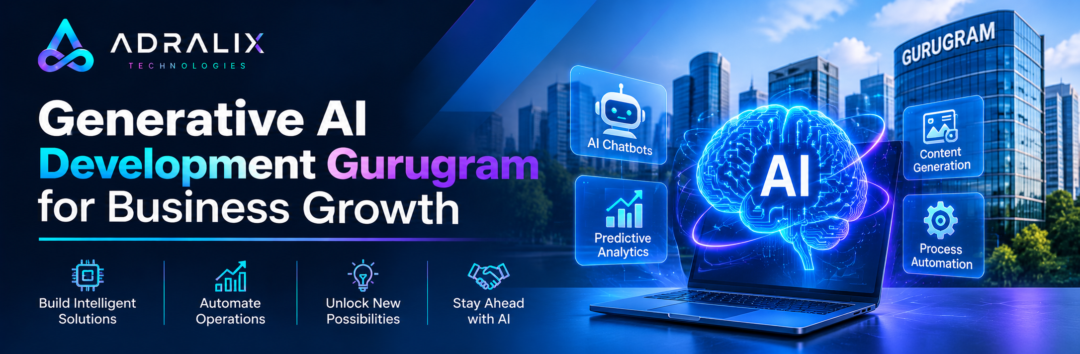
Generative AI Development Gurugram is becoming a practical consideration for organisations that want to improve how employees access information, process requests and complete repeatable knowledge work. For businesses in Gurugram and Delhi-NCR, the opportunity is not to add AI to every process. It is to identify where language, documents, search or reasoning can make an existing workflow more useful without weakening control, accuracy or accountability.
The difference between an AI experiment and a dependable business solution is the surrounding system. Teams need to define what the solution is allowed to do, which data it can access, when a person must review an output and how performance will be evaluated. This is where engineering, integration and product thinking become as important as model selection.
Quick Answer
Generative AI can help businesses improve knowledge access, automate selected workflows, support customer interactions and accelerate internal work. The strongest results come from use cases with clear owners, reliable data, measurable outcomes and human review. A successful AI initiative is not simply a chatbot or model connection; it is a product and workflow decision supported by secure integration, evaluation and ongoing governance.
Key Facts
- Generative AI can support text, code, document and conversational workflows.
- A useful AI use case starts with a repeated business task or decision bottleneck.
- Retrieval, permissions and data quality influence the reliability of AI responses.
- Human review is important for sensitive, regulated or high-impact decisions.
- Model quality, response time, cost and user adoption should be measured after launch.
Industry Statistic
McKinsey’s 2025 State of AI survey found that 79% of respondents said their organisations regularly used generative AI in at least one business function. The figure describes survey respondents’ organisations globally; it is not a Gurugram-specific adoption rate.
Where Can Generative AI Development Gurugram Create Practical Business Value?
Generative AI is most useful when employees repeatedly read, classify, summarise, search or draft information. It can reduce the effort involved in these activities, but it should not be treated as an automatic replacement for business expertise. The process owner still needs to define acceptable outputs and exceptions.
Common opportunities include:
- Internal knowledge assistants: Help employees search approved policies, product documents, process notes and support material through natural-language questions. Responses should point to relevant source content so users can verify important details.
- Customer and service support: Draft responses, classify incoming requests, summarise conversations and surface suggested next steps. Escalation rules should send uncertain or sensitive cases to a person.
- Document processing: Extract fields from forms, organise contracts or reports, summarise lengthy files and route exceptions for review. Validation is essential when extracted data enters business systems.
- Sales and operations assistance: Prepare account summaries, organise meeting notes, draft follow-ups and retrieve product information from authorised sources.
- Software engineering support: Assist with code explanation, documentation, test-case ideas and developer knowledge search while keeping code review and security checks in place.
The McKinsey finding above indicates that generative AI use has spread across business functions. It does not establish that every organisation is achieving measurable returns. Businesses still need to connect adoption to a defined operational result.
| Approach | Best Suited To | Main Consideration |
|---|---|---|
| Rule-based automation | Stable, predictable steps and conditions | Rules must be maintained when processes change |
| Traditional machine learning | Classification, prediction and pattern recognition | Requires suitable data and model evaluation |
| Generative AI | Language, content, summarization and knowledge workflows | Outputs can be inaccurate and require controls |
What Should a Business AI Solution Include?
A business-ready solution usually combines an AI model with application logic, data access, user permissions and monitoring. This distinction matters in enterprise AI development and custom AI integration: the model is only one layer in an operating product. Connecting a model to an interface is only one part of the work. The design must address how the system receives information, what it can retrieve, what it returns and what happens when it is uncertain.
A practical architecture may include:
- User experience: A chat, form, workflow panel or embedded assistant that fits the employee’s existing task.
- Application layer: Business rules, routing, authentication, permissions and connections to the systems employees already use.
- Knowledge and data layer: Approved documents, databases or APIs, with access controls and a process for updating information.
- Model and prompt layer: The selected model, instructions, context handling and response format suited to the use case.
- Evaluation and monitoring: Test cases, feedback, error review, usage metrics, latency and cost monitoring.
For example, an internal policy assistant should not retrieve every document available to the organisation. It should respect role permissions, identify the source of an answer and avoid presenting an unsupported response as fact. That requirement needs to be designed into the solution rather than added after launch.
How Should Organisations Move from an AI Pilot to Implementation?
An effective rollout is narrow at first, measurable and designed to learn. A staged approach reduces the risk of investing in a broad platform before the organisation understands user behaviour and operational constraints.
- Select one workflow: Choose a frequent task with visible effort, a clear owner and a manageable risk profile.
- Define the success measure: Track indicators such as handling time, response quality, rework, completion rate or employee adoption. Set a baseline before changing the workflow.
- Prepare approved data: Identify the sources the solution may use, remove irrelevant material, confirm permissions and establish an update process.
- Build and test a limited version: Create representative test scenarios, including unclear requests, missing data, conflicting information and attempts to access unauthorised content.
- Pilot with real users: Gather feedback, review failures and compare outcomes against the baseline before expanding access.
- Operate with oversight: Assign owners for model changes, data updates, incidents, access reviews and performance monitoring.
Do not measure success only by the number of prompts or generated responses. A solution that creates more content but increases review time may not improve the business process. A stronger measure connects system behaviour with a business outcome.
How Adralix Approaches Generative AI Development
Adralix Technologies lists Generative AI Development alongside web, backend, frontend, full-stack and QA capabilities. Its published engineering portfolio also includes Node.js, Python and API development, which are relevant when an AI feature needs to connect with an existing application or business system. This is a capability-based proof point, not a claim of a specific client result or guaranteed performance improvement.
For an organisation evaluating Generative AI solutions Gurugram, the engagement should begin with a use-case review: what task needs to improve, which information is permitted, what systems must connect and what level of human review is appropriate. The scope can then be shaped into a pilot or a larger product feature. Explore Adralix Generative AI Development Services and Node.js Development Services for related engineering capabilities.
Frequently Asked Questions
1. What Should Businesses Evaluate Before Choosing Generative AI Development Gurugram Services?
Start with the business workflow, data sensitivity, user roles, integration needs and the cost of an incorrect output. Ask how the provider will test answer quality, handle uncertainty, protect access and support the solution after launch.
2. Can AI Automation Services Gurugram Businesses Use Connect with Existing Software?
Yes, where the existing platform exposes suitable APIs or other supported integration methods. The integration design should define permissions, data movement, error handling and logging before the workflow is deployed.
3. Is a Generative AI Chatbot Enough for Enterprise Adoption?
Not necessarily. A chatbot may be the interface, but a dependable enterprise solution also needs approved knowledge sources, identity and access controls, evaluation, monitoring and escalation to a human when required.
4. How Should a Company Measure an AI Project?
Choose a baseline and track task completion time, quality, rework, user adoption, cost per task and exception rates. Compare the results with the previous workflow and review them over a meaningful operating period.
Build an AI Capability Around a Real Business Need
Generative AI Development Gurugram should begin with a business problem, not a model trend. Define one workflow, establish data and review controls, test the solution with representative users and expand only when the results justify it. Adralix Technologies can help assess the application, integration and engineering requirements behind a practical AI initiative. Discuss your requirements with Adralix.