 Post by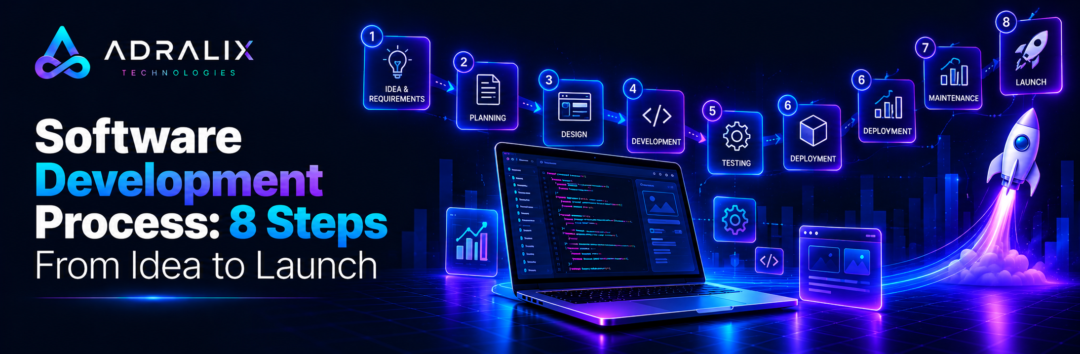
Software Development Process is the structured path businesses use to turn an idea, business problem, or user requirement into working software. It connects discovery, planning, design, development, testing, deployment, and maintenance.
Understanding the software development process helps teams make better decisions about technology, budget, timelines, security, and quality.
Quick Answer: What Is the Software Development Process?
The software development process is a repeatable framework for planning, designing, building, testing, releasing, and maintaining software. It is closely related to the Software Development Life Cycle (SDLC), which IBM describes as a structured and iterative methodology that breaks software creation into distinct, repeatable phases. SDLC helps teams manage scope, costs, timelines, risks, documentation, and alignment with organizational goals.
A typical software development process includes requirements, analysis, design, coding, testing, deployment, and maintenance. Agile teams may repeat these activities across short iterations.
Software Development Process at a Glance
| Stage | Objective | Typical Output |
| 1. Discovery | Define the problem | Requirements and goals |
| 2. Planning | Set scope and roadmap | Priorities and milestones |
| 3. Design | Shape the experience | Wireframes and prototypes |
| 4. Technology | Choose architecture | Tech stack and architecture |
| 5. Development | Build the product | Working software |
| 6. Testing | Verify quality | Release candidate |
| 7. Deployment | Release to users | Production application |
| 8. Maintenance | Improve the product | Updates and optimization |
Software Development Process: 8 Key Steps
- Requirements Gathering and Discovery
Every project starts by defining the problem. Teams identify business goals, target users, functional requirements, integrations, technical constraints, security expectations, and success metrics.
For example, an eCommerce business may need a new platform because its current store cannot support a growing catalog or complex integrations. Mapping user journeys and business rules before coding makes the software development process more predictable.
- Planning and Scope Definition
Teams then define scope, milestones, resources, dependencies, risks, and release targets. New products often begin with an MVP focused on the core user problem.
Good planning gives the software development process a practical roadmap while making scope changes visible.
- UI/UX Design and Prototyping
Design converts requirements into user flows, wireframes, prototypes, interfaces, and reusable components. UX focuses on tasks, while UI shapes the visual and interactive experience.
Prototypes help stakeholders identify confusing navigation and missing interactions before development, reducing avoidable rework.
Adralix’s UI/UX Design Services can support research, prototyping, visual design, and development-ready handoff.
- Technology and Architecture Selection
Technology should follow product requirements, not trends. Teams may evaluate frameworks, backend languages, databases, APIs, cloud platforms, security, and integrations.
A project may use ReactJS Development Services or NextJS for the frontend and NodeJS, Python, PHP, Laravel, or Java for backend services. Full-stack applications may use MERN or MEAN.
Scalability, performance, maintainability, developer availability, security, and total cost all influence the long-term software development process.
- Development and Implementation
Engineers translate designs and specifications into working software. Frontend developers build interfaces, backend developers implement business logic and APIs, and full-stack developers can work across multiple layers.
Teams commonly use version control, code reviews, issue tracking, development environments, and automated checks. Incremental delivery makes work easier to review and refine.
Adralix supports implementation through Web Development, Full Stack Development, Mobile App Development, and IT Staff Augmentation.
- Testing and Quality Assurance
Testing verifies requirements and behavior. QA may include:
- Functional testing
- Regression testing
- Usability testing
- Compatibility testing
- API testing
- Performance testing
- Security testing
Manual testing is useful for exploratory scenarios and realistic user behavior, while automated testing provides repeatable checks for regression-prone functionality.
Security also belongs inside the software development process. NIST recommends integrating secure development practices into each SDLC implementation to reduce vulnerabilities and address root causes.
- Deployment and Release
After validation, software is prepared for production through infrastructure configuration, database changes, monitoring, approvals, and rollback plans.
CI/CD practices can automate parts of this workflow, making releases more repeatable and observable.
A release is not simply the moment code goes live. Production verification and monitoring remain part of the software development process.
- Maintenance and Continuous Improvement
Launching software is the beginning of its operational life. Teams may fix defects, update dependencies, improve security, optimize performance, and add features.
A mature software development process creates a feedback loop:
Release → Measure → Learn → Improve → Repeat
Maintenance can also include technical debt management, analytics review, infrastructure updates, documentation, and compatibility improvements.
What Are the Main Software Development Methodologies?
Software development methodologies determine how teams organize work across the broader software development process.
| Methodology | How It Works | Suitable When |
| Agile | Short cycles and continuous feedback | Requirements may change |
| Waterfall | Sequential phases | Requirements are stable |
| Iterative | Repeated improvement cycles | Product needs validation |
| DevOps | Development and operations work together | Frequent, reliable releases |
Agile emphasizes working software, collaboration, and responding to change.
Waterfall is more sequential. Iterative development relies on repeated learning cycles, while DevOps connects development, delivery, monitoring, and operations.
There is no universal methodology. The right software development process depends on product complexity, uncertainty, compliance, release frequency, and team structure.
Read More: Custom Software Development vs Off-the-Shelf Software: Which Is Right for Your Business?
Software Development Process: Statistics That Matter
The modern software development process is changing rapidly as AI-assisted coding, developer platforms, and collaborative development become more common. Businesses are also integrating AI into applications through Generative AI Development Services, including LLM-powered applications, AI copilots, RAG systems, and AI-enabled workflows.
| Statistic | What It Shows | Source |
| 49,019 respondents | Scale of the 2025 Stack Overflow Developer Survey | Stack Overflow 2025 Developer Survey |
| 84% | Respondents using or planning to use AI tools in development | Stack Overflow AI Survey |
| 51% | Professional developers using AI tools daily | Stack Overflow AI Survey |
| 180M+ | Developers on GitHub in 2025 | GitHub Octoverse 2025 |
| Nearly 1B | Commits pushed to GitHub during 2025 | GitHub Octoverse 2025 |
| 230+ per minute | New repositories created on GitHub | GitHub Octoverse 2025 |
| 90% | DORA 2025 respondents using AI at work | DORA 2025 Report |
| 80%+ | DORA respondents reporting productivity improvements from AI | DORA 2025 Report |
| 30% | Respondents reporting little or no trust in AI-generated code | DORA 2025 Report |
| 90% | Organizations reporting adoption of at least one internal platform | DORA 2025 AI Capabilities Model |
The 2025 Stack Overflow Developer Survey collected 49,019 responses. It reports that 84% of respondents are using or planning to use AI tools in development, while 51% of professional developers use AI tools daily.
GitHub’s 2025 Octoverse reported more than 180 million developers, nearly 1 billion commits, and more than 230 new repositories created every minute. It also reported that India added more than 5 million developers to GitHub during 2025.
DORA’s 2025 research, based on responses from nearly 5,000 technology professionals, found that 90% of respondents reported using AI at work, more than 80% reported productivity improvements, and 30% reported little or no trust in AI-generated code. DORA describes AI as an amplifier of existing organizational strengths and weaknesses rather than a substitute for strong engineering practices.
The takeaway is straightforward: faster code generation does not remove the need for requirements, testing, security, code review, monitoring, and human oversight. These controls remain central to the software development process.
How Long Does the Software Development Process Take?
There is no universal timeline. A simple website may take weeks, while a complex SaaS platform can require months or longer.
The timeline depends on:
- Scope and feature count
- Integrations and dependencies
- UI/UX complexity
- Team size and experience
- Architecture and technology choices
- Testing, security, and approval requirements
A better estimate breaks the software development process into stages, defines an MVP, and estimates major deliverables.
Common Software Development Mistakes to Avoid
The most common mistakes include:
- Starting without clear requirements
- Allowing uncontrolled scope expansion
- Choosing technology before understanding the problem
- Treating testing as a final checkbox
- Ignoring security until launch
- Releasing large changes without monitoring
- Forgetting maintenance and technical debt
NIST recommends integrating secure development practices into SDLC implementations rather than adding security only at the end.
How to Make the Software Development Process More Effective
Start with a clearly defined business problem. Establish measurable requirements, prioritize the MVP, document technical decisions, involve users early, automate repeatable checks, and evaluate performance continuously.
A Practical Checklist
| Area | Question |
| Business | What problem are we solving? |
| Users | Who will use the product? |
| Scope | What belongs in the MVP? |
| Technology | Why is this stack appropriate? |
| Quality | How will critical workflows be tested? |
| Security | Where are the major risks? |
| Release | How will deployment and rollback work? |
| Monitoring | Which metrics show product health? |
Cross-functional collaboration matters. Stakeholders, designers, developers, testers, and operations need shared visibility into priorities, dependencies, and risks. This keeps the software development process connected to business outcomes.
Frequently Asked Questions About the Software Development Process
What are the seven phases of software development?
Common SDLC models include planning, analysis, design, coding, testing, deployment, and maintenance. Agile teams may repeat several activities across short iterations.
What is the difference between SDLC and the software development process?
SDLC is a lifecycle framework for organizing software work from planning through maintenance. The software development process is broader and can include the methods, workflows, roles, tools, and practices used to deliver software.
Which software development methodology is best?
There is no single methodology for every project. Agile can suit evolving products, while sequential approaches may work better when requirements and approvals are stable.
Does software development end after launch?
No. Monitoring, bug fixes, security updates, performance improvements, technical debt management, and new features remain part of the software development process.
Conclusion
The software development process turns a business requirement or product idea into working, tested, deployed, and maintainable software. Its core stages include discovery, planning, design, technology selection, development, testing, deployment, and continuous improvement.
The strongest approach is not a rigid checklist. Businesses should create a software development process that matches their users, complexity, risks, technology, and delivery model.
For a website, mobile app, eCommerce platform, enterprise application, or AI product, a structured software development process provides the foundation for quality and sustainable product development.